
AI Search for Tradies: How to Become a Useful Source for ChatGPT and Google AI
When customers ask ChatGPT or Google AI who to call, the answer names two or three businesses. Here's how Australian tradies get named, how to write pages an AI can quote, and a 15-minute monthly check to see if it's working.

Mitchell Gibb
Founder
On this page
Key takeaways
- Two jobs, not one — Getting named depends on your Google Business Profile, reviews and consistent business details. Getting quoted depends on clear pages that answer real customer questions.
- Protect the map pack first — For urgent trade searches in Australia, the Google map pack is still the main shopfront. AI answers add a second one. They don't replace the first.
- Reviews need the suburb and the job — Ask every customer the same way, the same day, and invite them to mention where you were and what you did.
- Write sentences that stand on their own — Name the job, the area, the next step and where your licence can be checked. Don't invent prices, warranties or statistics.
- Check monthly, fix one thing — Run five prompts in ChatGPT and Google, note who gets named, and change one thing at a time.
A homeowner in Cronulla needs an old switchboard replaced. Instead of scrolling past ads, they open ChatGPT and type: "Who's a good electrician near Sutherland who can upgrade a switchboard?" They get back two or three business names and a line on why each one fits. If you're not one of those names, you weren't in the running for that job.
That's what AI search for tradies comes down to. Tools like ChatGPT, Gemini, Perplexity and Google's own AI features answer with a short list instead of ten blue links. This guide covers what those tools look at, why your Google Business Profile and reviews still do most of the work, how to write pages an AI can quote without getting the details wrong, and a 15-minute monthly check to see whether any of it is working.
One thing up front: for most urgent trade searches in Australia, the Google map pack is still where jobs are won. AI search adds a second shopfront. It doesn't replace the first one.
What AI search actually means for a tradie
AI search is when someone asks a question in full sentences and gets a written answer, rather than a list of links to sort through themselves. For a trade business, the questions look like this:
"Who's a reliable electrician near Sutherland for a switchboard upgrade?"
"Blocked drain in Penrith, who can come out today?"
"How much does it cost to replace a hot water system in Perth?"
The first two ask for a name. The third asks for an explanation, and the tool will usually build that from a handful of web pages and link to them.
Plenty of Australians are already asking. Roy Morgan research published in June 2026 found 13.6 million Australians aged 14 and over (58%) used AI tools in an average four weeks in the March quarter, with ChatGPT used by 10.5 million people and Google Gemini by 5 million. That measures AI tool use in general, not people looking for a tradie, so treat it as a sign of where habits are heading rather than proof your jobs have moved.
GEO and AEO in plain English
You'll see this work called GEO (generative engine optimisation) or AEO (answer engine optimisation). Google's own view is blunt. Its guide to optimising for generative AI search says that, from Google Search's point of view, optimising for AI search is still SEO. The labels matter less than the two outcomes you want: an assistant can confidently name your business, and it can quote your explanation of a job without making up the details.
A quick clarification. Some people searching for "AI for tradies" want tools that write quotes or answer the phone. That's a different job. This guide is about being found and recommended.
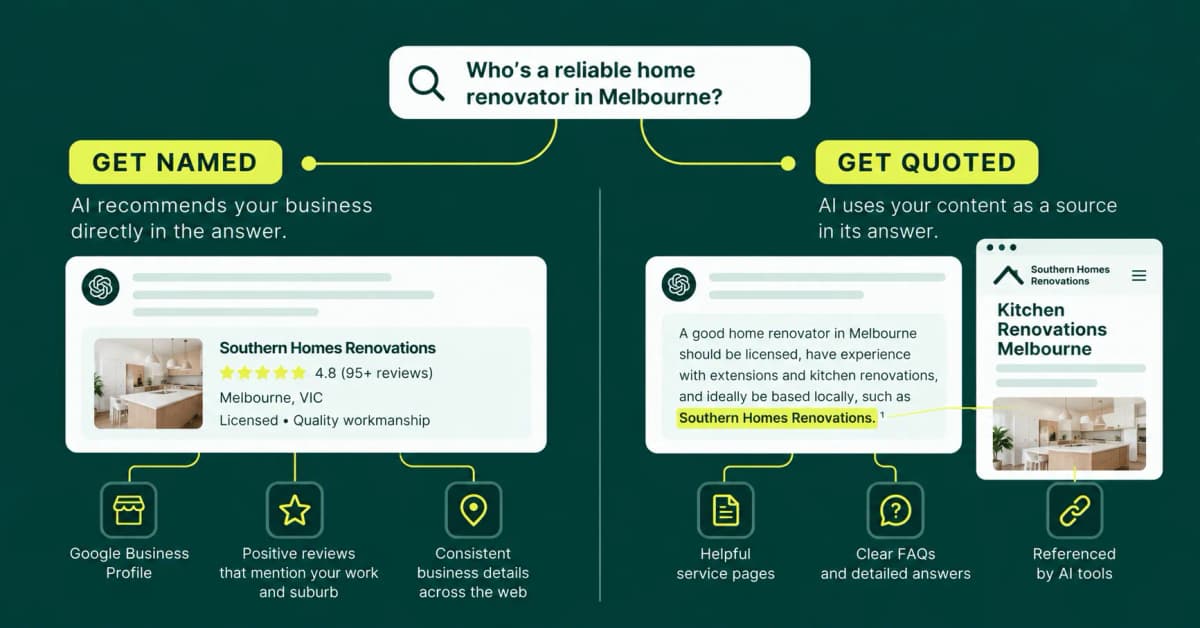
Two jobs: get named, and get quoted
Most advice on AI search optimisation lumps everything into one checklist. It's easier to split it into two tracks, because different things feed each one.
Track | The question it answers | What feeds it | Example |
|---|---|---|---|
Recommendation track | "Who should I call?" | Google Business Profile, reviews, consistent business details across directories, licence records | "Plumber in Penrith who can come today?" |
Source track | "How does this work?" or "What affects the cost?" | Clear service pages and FAQs on your website | "What's involved in a switchboard upgrade?" |
The recommendation track is where the jobs are. The source track builds trust and can put your site in front of someone earlier, while they're still working out what they need. A clear page also helps the first track, because it gives an assistant something specific to confirm what you do and where.
If you're short on time, finish the first track before starting the second. A complete profile and a steady run of specific reviews will do more for "who should I call?" than a long article about AI.
Where Australian customers actually see AI answers
"AI search" isn't one place. Each surface works differently, and they don't all matter equally for trade work.
On Google
Surface | What it is | What it means for tradies |
|---|---|---|
Map pack (local results) | Three businesses on a map, with stars, hours and a Call button | Still the main shopfront for "trade plus suburb" searches. Fed by your Business Profile. |
AI Overviews | A written summary above the results, with links to sources | Rolled out Australia-wide on 29 October 2024. Google says they only show when they add something, and often don't appear at all. More likely on "how" and "how much" questions than on "plumber near me". |
AI Mode | A separate conversational search tab | Arrived in Australia in October 2025. Built for longer, comparison-style questions. |
Ask Maps | Gemini-powered questions inside Google Maps | Began rolling out in Australia in August 2026. It runs inside Maps, so the businesses it can suggest are ones with a Maps listing. |
Google also explains that AI Overviews and AI Mode can use a "query fan-out", running several related searches behind the scenes and drawing on all of them. That's one reason a page doesn't have to rank on page one for the exact question to be cited. An Ahrefs study of 863,000 searches, published in March 2026, found only about 38% of pages cited in AI Overviews also ranked in the top 10 for that same search. It's global data from an SEO software company, not Australian trade searches, but the direction is useful: a page that clearly answers part of a bigger question can still get pulled in.
ChatGPT, Claude, Gemini and Perplexity
Standalone assistants work a little differently. OpenAI’s help page on ChatGPT search says it can search the web, use a rough location from the person’s IP address to find local results, and show a map on mobile. It also says ChatGPT sometimes sends rewritten searches to third-party search providers, and that placement in its results isn’t guaranteed.
Claude, made by Anthropic, can also search the web and cite the sources it used when web search is turned on. Anthropic runs separate crawlers for this. Claude-SearchBot indexes pages for search, and Claude-User fetches a page when someone’s question needs it. Anthropic says blocking either one may reduce your site’s visibility in Claude’s search results. Gemini and Perplexity also search the web and show the sources behind their answers.
Claude has a much smaller Australian audience than ChatGPT. Roy Morgan’s June 2026 research put it at around 777,000 users in an average four weeks, compared with 10.5 million for ChatGPT. Still, making sure your site doesn’t block it costs nothing.
The practical upshot is the same for all of them. They need a business they can verify and a page they can quote. Neither can be bought, and neither can be faked for long
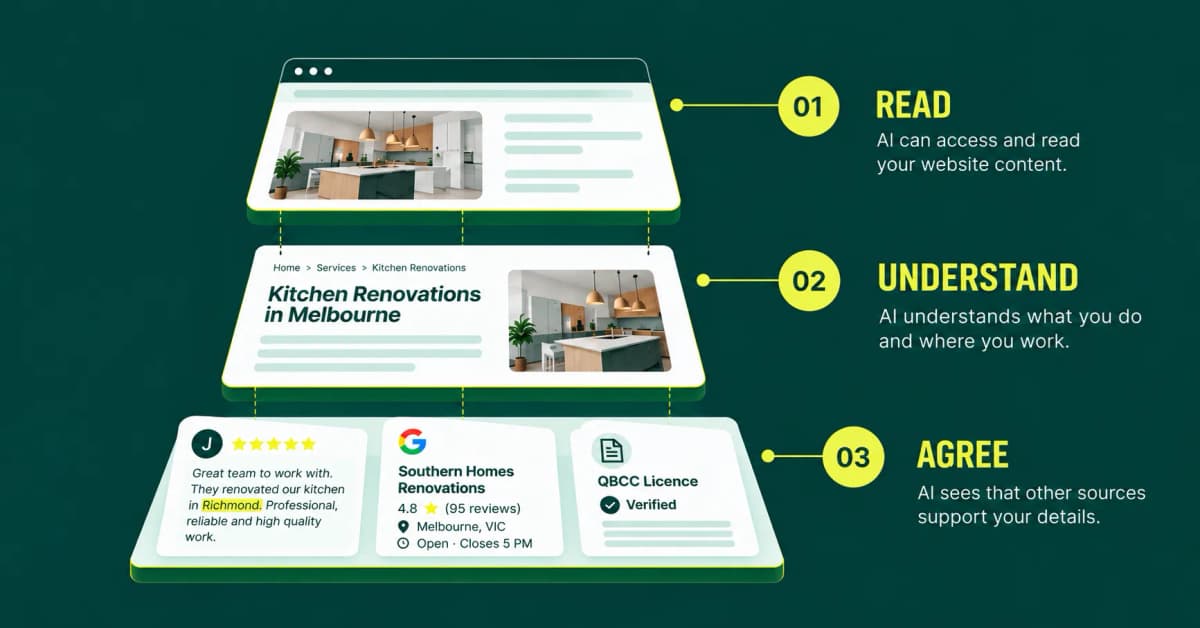
How an assistant decides who to name
No AI company publishes a formula for this. A useful way to think about it is three checks your business needs to pass before an assistant can comfortably name it.
1. Can it read you?
If a crawler can't load your page, nothing on it counts. Google says a page has to be indexed and eligible to show with a snippet to appear in its AI features, and lists basics like allowing crawling in robots.txt and through your hosting or CDN, and keeping important content in text rather than locked in images. For ChatGPT, OpenAI says a site has to allow its OAI-SearchBot crawler to be eligible for search results.
The common tradie problems here are a services list that's actually one big image, prices and suburbs buried in a PDF, or a hosting security setting that blocks bots it doesn't recognise. A web developer can check all three quickly.
2. Can it understand a specific claim?
"Quality workmanship at competitive rates" can't answer anyone's question. "Residential electrician in Sutherland doing switchboard upgrades and safety switch installs" can. Specific sentences that name the job, the area and what happens next give an assistant something to match against the question it was asked.
3. Does anyone else agree?
This is the check most tradies skip. Your website saying you're licensed and local is one source. Reviews that mention the suburb and the job, the same business details on directories, and a licence number anyone can look up are others. When they line up, the claim is easier to trust. When your website says Penrith, your Hipages profile says Blacktown and your Google profile shows an old phone number, there's less to go on.
Licence records are public, so put your number where people can check it: the QBCC registers in Queensland, the Service NSW licence check in New South Wales, and the Building and Plumbing Commission or Energy Safe Victoria in Victoria, depending on your trade. Other states have their own regulators. A listed licence won't make an assistant mention you on its own. It does give a customer, or a tool, something solid to confirm.
The recommendation track: getting named as the business
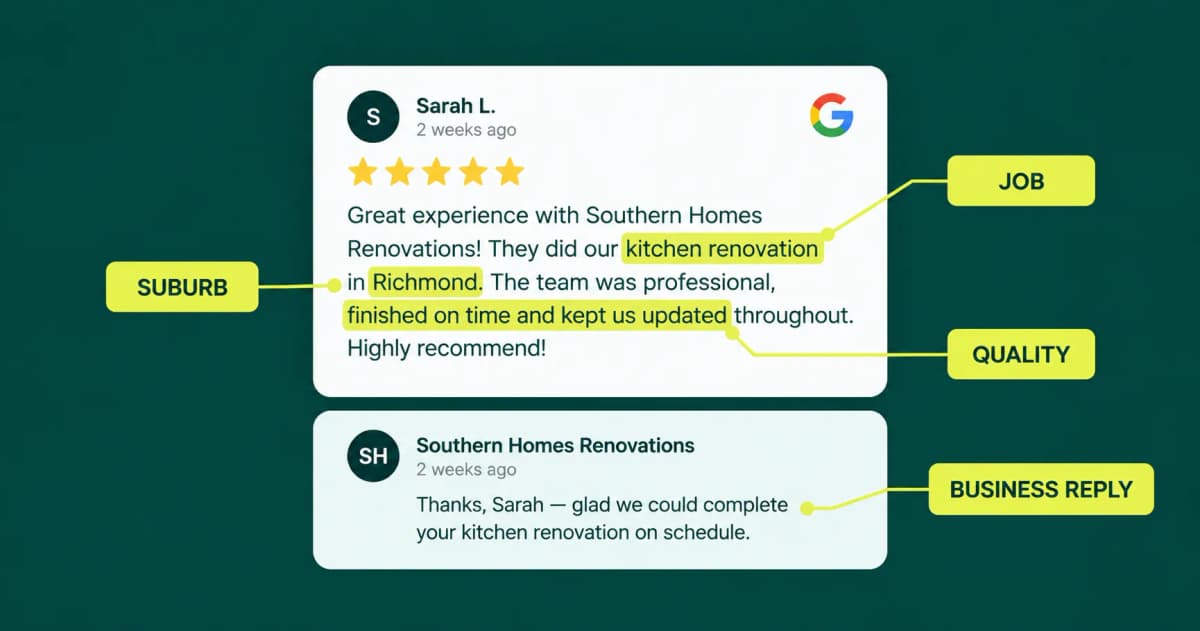
Reviews that mention the suburb and the job
A review that says "Great service, highly recommend" tells a person almost nothing, and gives an assistant nothing to match. Compare it with: "Replaced our old switchboard in Engadine two days after we called. Explained the safety switch options before starting and left the place tidy." That one tells everyone which job and which area the business fits.
You can't write reviews for customers, and you shouldn't try. You can make it easy for them to include the useful details. Send something like this the same day the job is signed off:
Thanks for having us out in [suburb] for the [job, e.g. hot water replacement]. If you're happy with the work, a Google review really helps other locals find us. Mentioning the suburb and what we did is a big help. Here's the link: [your review link]. Cheers, [name].
Ask every customer the same way, not only the happy ones. Google's review policy bans selectively asking for positive reviews, and the ACCC is clear that creating or arranging fake or misleading reviews is against the law. One honest review a week beats twenty in a month and then nothing.
What makes a review useful, for a person reading it or an AI tool:
The suburb or area
The job, in the customer's own words
Something specific about timing, communication or the result
A reply from you that mentions the job too
Google's generative AI guide says that keeping your Business Profile up to date helps your services show in AI responses as well as in normal search results. For a tradie, that means the right primary category, every service listed on its own line with a sentence about it, an accurate service area, real hours, and your licence number in the description. Our Google Business Profile guide for tradies walks through each of those step by step, so we won't repeat it here.
One business name, one number, everywhere
Check that your business name, phone number, suburb and website are identical on every listing that matters: Google, Bing Places, Hipages, ServiceSeeking, your trade association's directory and your own website. Old numbers from a previous business, or a tracking number that has since been cancelled, are the usual culprits. It's dull work, and it's one of the few things that directly helps the "does anyone else agree?" check.
The source track: pages an AI can quote
Answer the question in the first few sentences
When someone asks how much a hot water system costs in Perth, an assistant looks for a page that answers that directly and early. A page that spends three paragraphs on company history before it gets there is harder to use. Put the answer near the top, then the detail.
You don't need to publish a price to answer a cost question honestly. Explain what moves it: gas or electric, storage or continuous flow, a like-for-like swap or a relocation, access, and whether the old unit needs removing. That's genuinely useful to a homeowner, and it's the kind of first-hand detail an assistant can't invent.
A service paragraph an assistant can lift
Here's the difference between copy that says nothing and copy that can be quoted on its own.
Electrician, weak: "We are a trusted local electrician offering quality workmanship and competitive rates across the greater Sydney area."
Electrician, stronger: "We're a residential electrician based in Sutherland. Most of our work is switchboard upgrades, safety switch installs and fault finding in homes across Sutherland, Cronulla and Engadine. When you call, we confirm your suburb, ask for a photo of the switchboard if you have one, and give you a time window. Our NSW contractor licence number is listed on this page so you can check it with Service NSW."
Deck builder, weak: "Your dream outdoor space starts here. We build decks and pergolas to the highest standard."
Deck builder, stronger: "We design and build timber and composite decks and pergolas on the southern Gold Coast, mostly in Robina, Burleigh Heads and Varsity Lakes. Every job starts with a site visit to measure up and check whether building approval is needed. We're QBCC licensed, and our licence number is at the bottom of this page."
The stronger versions still make sense when they're lifted out on their own. Each one names the trade, the base area, the main jobs, the next step and where to check the licence. Neither invents a price, a warranty or a statistic.
What a good service page covers
For each main service, answer what a customer would ask you on the phone:
What the job is, in one or two plain sentences
Who it's for, and when it's urgent versus when it can wait
The suburbs or area you cover for this job
What happens after they call or send a quote request
Rough timing, if you can state it honestly
What affects the price
Licence and insurance details
A short FAQ built from questions you actually get asked
Our guide to tradie website conversion covers how to lay that page out so the call and quote buttons do their job once someone lands.
Service pages, suburb pages and what not to publish
Suburb pages can help when each one says something genuinely local: the jobs you do most in that area, typical housing, access issues, how quickly you can get there. Fifty copies of the same page with only the suburb name swapped are a different matter. Google's spam policies treat those as doorway pages, and its AI guide warns that mass-producing pages to chase every variation of a question breaches its scaled content abuse policy.
Leave out anything you can't stand behind, too: made-up price ranges, case studies that didn't happen, "24/7" when nobody answers at 9pm, or AI-written filler that says what every other site says. Google's guide says unique, first-hand content is likely to matter more for AI search over time than any other tactic it lists. That's the one advantage a local tradie has over a national directory, so use it.
A four-week plan for a busy tradie
You don't need to do all of this at once. Here's an order that fits around a full week on the tools.
Week 1: profile and review routine
Check your Google Business Profile: category, services, service area, hours, and your licence number in the description.
Save the review message as a text shortcut on your phone and send it after every job from now on.
Week 2: listings check
Search your business name and check Google, Bing Places, Hipages, ServiceSeeking and any association directory. Fix any name, number or suburb that doesn't match.
Add your licence number to your website footer and contact page.
Week 3: one service page
Pick the job you most want more of. Rewrite the top of that page so the first few sentences name the job, the area, the next step and your licence.
Add five real customer questions as a short FAQ.
Week 4: baseline check
Run the monthly prompt check below and write down who gets named. That's your starting point.
What to hand to your web developer
Confirm robots.txt and any hosting or CDN security settings allow Googlebot and OAI-SearchBot.
Make sure services, suburbs and prices aren't trapped in images or PDFs.
Check mobile page speed and fix the slowest pages first.
Add LocalBusiness structured data that matches the visible page.
Verify the site in Google Search Console so you can see how it performs in search and AI features.
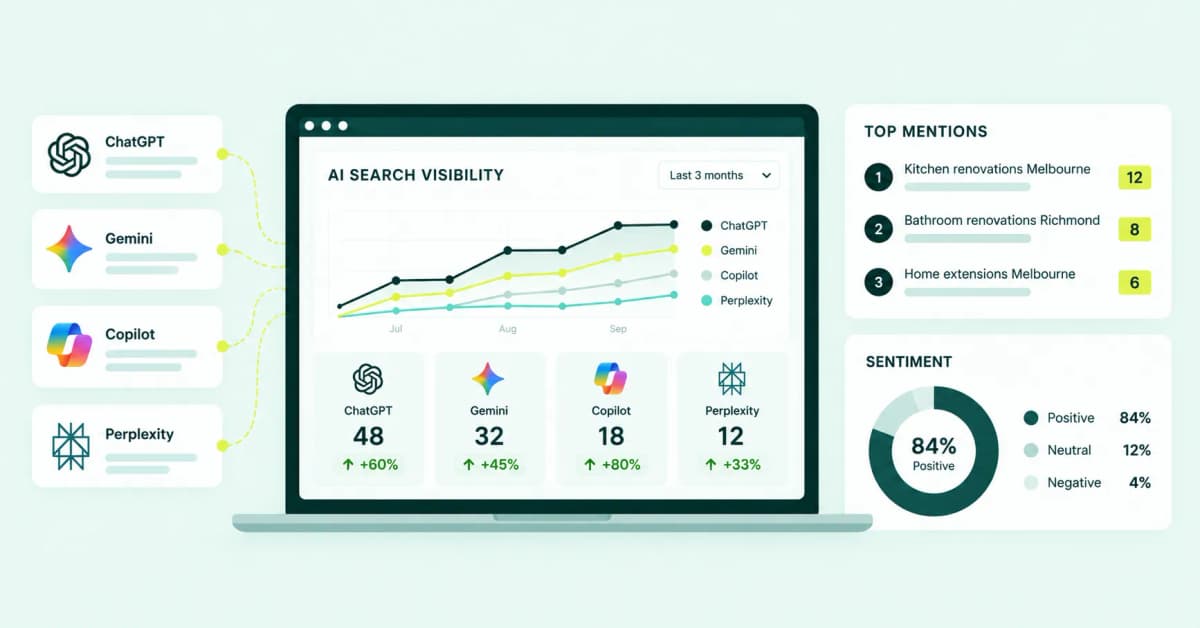
How to check whether AI tools are naming your business
No software needed. Once a month, open a fresh chat in ChatGPT and a Google search on your phone, and run these with your trade and two suburbs you actually cover:
Who's a reliable [trade] in [suburb]?
Can you recommend a [trade] for [specific job] near [suburb]?
Emergency [trade] in [suburb], who can come today?
What should I check before hiring a [trade] in [state]?
How much does [common job] cost in [city]?
Note the date, the tool, the question, which businesses were named and which websites were linked as sources. A notes app or a simple spreadsheet is fine. Answers change from one run to the next, so look for patterns over a few months rather than reacting to a single result.
If you're missing, don't rewrite the whole site. Check three things: does your profile list that job, does any review mention that suburb, and do your details match on the directories the answer linked to. Fix one, then check again next month. If your site is verified in Search Console, Google also has a Generative AI performance report that shows how your pages appear in its AI features.
Common mistakes that keep tradies out of AI answers
Mistake | Why it hurts | Fix |
|---|---|---|
"We service all of Sydney", with no suburbs or jobs named | Gives an assistant nothing specific to match | Name your base, the suburbs you actually cover and your main jobs |
Reviews that only say "great job" | No job or area for anyone to match | Ask customers to mention the suburb and what you did |
Different phone numbers on different listings | Harder to confirm it's the same business | Pick one number and update every listing |
Services list saved as an image or PDF | Crawlers can't read it reliably | Put services in plain text on the page |
Hosting security blocking crawlers | Your pages never get read | Ask your developer to check robots.txt and CDN settings |
Fifty near-identical suburb pages | Can be treated as doorway pages | Fewer pages, each with genuinely local detail |
Paying for an "AI visibility" fix before the basics | Nobody can guarantee a mention | Do the profile, reviews and one strong service page first |
AI search for tradies isn't a new channel you have to master from scratch. It rewards what a careful customer already looks for: a business they can check, reviews from people nearby, and a straight answer to their question. Get the profile and reviews right, make one service page genuinely useful, and check once a month. That puts you ahead of most trade businesses in your area, whether the customer is scrolling the map or asking ChatGPT. If you'd like help with the profile and website side, our local SEO team works with trade businesses across Sydney, Melbourne, Brisbane and beyond, and our web design team builds service pages around the questions customers actually ask.
Frequently asked questions
What is AI search optimisation for tradies?
It's making your business easy for tools like ChatGPT, Gemini and Google's AI features to recommend and quote. In practice that means a complete Google Business Profile, reviews that mention the suburb and the job, the same business details on every listing, and website pages that answer real customer questions in plain sentences. Google treats it as part of normal SEO rather than a separate discipline.
How do I get my business recommended by ChatGPT?
Make sure your website allows OpenAI's OAI-SearchBot crawler, then focus on what ChatGPT can verify: consistent business details across listings, reviews that name the job and suburb, and service pages that say what you do, where, and how to book. OpenAI says placement isn't guaranteed, so treat this as making your business easier to confirm, not a switch you can flip.
Does my Google Business Profile still matter for AI search?
More than ever. It feeds the map pack, which still leads most local trade searches, and Google's own guidance says an up-to-date Business Profile helps your services show in its AI responses too. Ask Maps, Google's AI chat inside Maps, also works from Maps listings. If you only have time for one thing, make it your profile.
Will Google's AI answers replace the map pack for plumbers and electricians?
Not on current evidence. Google says AI Overviews only appear when they add something to the results and often don't show at all. They're designed for more complex questions, so they turn up more on 'how' and 'how much' searches. For urgent searches like 'emergency plumber' plus a suburb, the map pack with its Call buttons is still what most people see first.
What should I ask customers to write in a review?
You can't tell them what to say, but you can ask them to mention the details that help: the suburb and the job you did. Send your review link the same day, ask every customer the same way, and never offer anything in return. A review like 'switchboard replaced in Engadine, explained the options first' helps far more than 'great service'.
How long before AI tools start mentioning my business?
There's no fixed timeline. Profile updates and new reviews can be picked up within weeks, but being named consistently depends on how many specific reviews you build, how well your details line up across the web, and how strong your local competitors are. Run the same monthly prompt check and judge progress over three to six months, not one.
Is traditional SEO still worth doing for tradies?
Yes. Google says its AI features are built on its core search ranking systems and the same SEO best practices apply, with no special extra requirements. A site that's crawlable, quick, clear about services and suburbs, and backed by a strong Business Profile is what both normal search and AI search draw on. Our guide to <a href="/blog/seo-vs-google-ads-for-tradies">SEO vs Google Ads for tradies</a> covers where to start.
Can anyone guarantee my business will show up in ChatGPT or Google AI?
No. OpenAI says placement in ChatGPT search isn't guaranteed, and Google says indexing and serving aren't guaranteed either. Google also warns that no third-party tool has access to its internal ranking or AI systems. Be wary of anyone promising a guaranteed AI mention. What you can do is make your business easy to verify and your pages easy to quote.