







From inconsistent work → a full calendar
“Now I don't have a week where my schedule isn't full, I'm turning away work.”
 Anthony BaldwinOwner of Top Tier Building Inspections
.webp&w=412&q=75)

A deep market where property services, renovation and urgent repairs pull demand in different directions.
Sydney's trade market isn't one search landscape, it's dozens. Demand shifts between property services, renovation work and urgent repairs, and the level of competition changes again once a search narrows to a specific suburb.
Across Sydney's core trades, demand and ranking difficulty move independently of each other. The biggest search in your category is rarely the best place to start.
Outside the core trades, the largest searches in Sydney belong to property services. “Pest control Sydney” records 6,600 monthly searches and “Removalists Sydney” 5,400, with “Rubbish removal Sydney” at 3,600 and “Termite control Sydney” at 1,300. Keyword difficulty across those terms runs from 38 to 54, and the results pull in national operators, franchises and directories alongside local businesses.
Within the trades, competition clusters at the top of each category. “Painters Sydney” has 1,600 monthly searches at a KD of 50, while “House painters Sydney” has 1,000 at 33. “Landscaping Sydney” sits at 57 and “Tree removal Sydney” at 58, among the hardest in the market, while “Fencing Sydney” and “Decking Sydney” both hold 880 searches at a KD of 22 and 26.
Specialist and finishing trades are quieter but far less contested. “Cabinet makers Sydney” has 480 monthly searches at a KD of 16, “Tilers Sydney” 390 at 22 and “Electrical contractors Sydney” 320 at 9. Across the Sydney trade terms reviewed, 44 of 100 sit at a keyword difficulty of 30 or below, which is where visibility is realistically winnable for an established business.
Here's what actually happened when tradies like you gave us a shot.
The problem isn't that Sydney customers aren't searching. It's who they find first.
Sydney is a crowded market for trade businesses. Your customers are already searching for plumbers, builders, roofers, painters, electricians, landscapers and other specialists across the suburbs you service.
The challenge is getting your business in front of them at the moment they are ready to compare options, request a quote or make a call.
A strong local SEO strategy gives your business more opportunities to appear across the searches that matter, rather than relying entirely on referrals, repeat customers or paid advertising.
SEO built around the jobs you actually want in Sydney
We don't start with a generic keyword list. We start with the work you want more of, the areas you want to service and the customers you want to attract.
Then we build the Google presence, website and supporting signals needed to help you get found and turn that visibility into genuine enquiries.
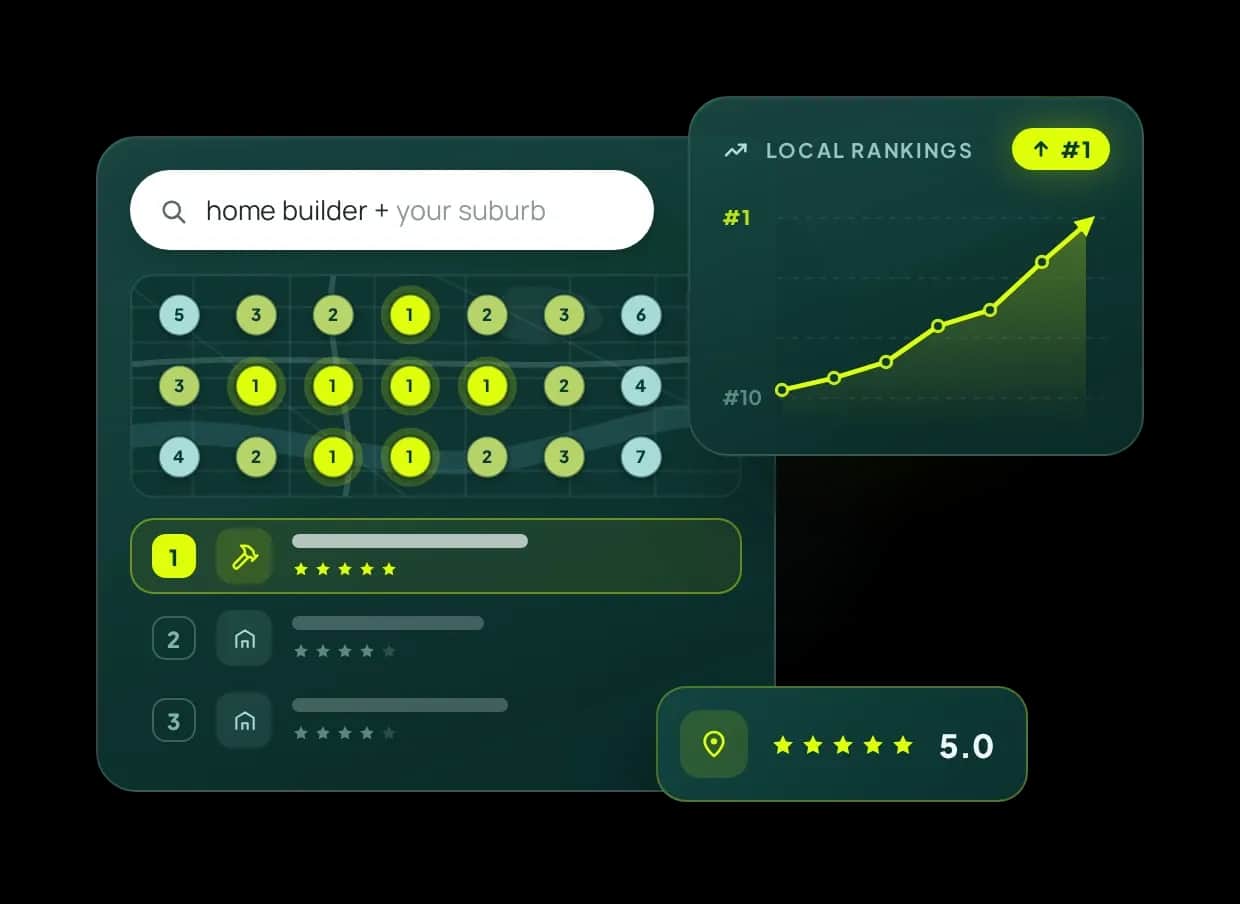
Most SEO proposals open with a list of search terms and a volume column. That tells you what people type. It does not tell you which of those searches lead to work worth having.
We start with the services that carry the strongest job value for your business, the Sydney suburbs where you can realistically deliver, and the customer you actually want on the other end of the phone. Keyword research follows those decisions rather than driving them.
Local results are shaped by proximity, relevance and prominence. Your Google Business Profile, service area signals, review activity and the consistency of your business information across the web all influence whether you appear for nearby searches.
In a city where suburb boundaries sit minutes apart, proximity does a lot of the work. We treat those signals as one system rather than a checklist, so category selection, service listings, review response and local content all reinforce what your business does and where it does it.
Ranking well brings a visitor to the page. What happens next depends on whether that page answers the question they arrived with: do you do this specific job, do you work in my area, have you done it before, and how do I get a price.
We build service and location pages that give search engines clear context and give the visitor an obvious next step: page structure, internal linking, relevant schema, and an enquiry path short enough that a tradesperson checking on a phone can finish it.
Authority and reputation are built across the services and locations that matter commercially. Local citations are cleaned up and made consistent, while relevant industry, supplier and association relationships can become credible mentions.
Review generation and response become part of the routine rather than an afterthought, because review activity influences both local visibility and whether someone chooses to call.
Don't take our word for it. Hear it from the businesses we've helped grow.
From inconsistent work → a full calendar
“Now I don't have a week where my schedule isn't full, I'm turning away work.”
Anthony BaldwinOwner of Top Tier Building InspectionsFROM CONSTANT WORRY → CHERRY-PICKING CLIENTS
“We went from 1 Million in revenue to 2.5M in 12 months. Comfortably”
 OliverOwner of Orb Constructions
From Uncertainty → Booked out
“We went from $30k a month to $50k a month.”
 Adam DeanFounder and Head Roofer at Fremantle Roofing Services
Are you ready to be the next success story?
A complete SEO system for a Sydney trade business.
The exact mix is tailored to your business, website, market and growth goals.
Commercial keyword research, search intent, competitor analysis and a prioritised roadmap for Sydney.
Technical health, indexation, crawlability, site structure, page experience and internal linking.
Pages built around the services and searches that can generate valuable trade enquiries.
Local signals, Google Business Profile optimisation and location relevance for your Sydney market.
A strategic suburb and service-area structure without mass-producing thin location pages.
Supporting content that answers customer questions and builds depth around your core services.
Recommendations that help turn organic visitors into calls, enquiries and quote requests.
Ongoing analysis and prioritisation based on visibility, enquiries and commercial outcomes.
How we turn SEO into a better lead channel
SEO isn't finished when a page starts ranking. We take the strategy from research and structure through technical work, content, optimisation and measurement, then use what the data tells us to keep improving.
We start by understanding the services you want to grow, the customers you want to attract and the Sydney areas you actually service. That gives us the commercial and search priorities the website needs to support.
We map the site around your priority services, locations and supporting topics so Google can understand the relationships between them and customers can move naturally from discovery to enquiry.
We improve the content and page experience so each important page answers the searcher's question, demonstrates why your business is a credible choice and makes the next step obvious.
Technical SEO, schema, indexation, page speed, search intent alignment and on-page signals are checked and refined. We do not assume the first version is the final version.
Once the work is live we measure what is moving, what is attracting the right searches and where enquiries are coming from. We then reinvest effort into the services, locations and topics with the strongest potential.
SEO is a growth process, not a switch you turn on.
Your timeline depends on competition, authority, website condition, search demand and how quickly the required work can be implemented.
Business discovery, technical review, competitor analysis, keyword mapping and the priority plan.
Priority fixes, service pages, local improvements, internal linking and the initial content work.
Scale the themes that are working, improve priority pages and build deeper authority around valuable services.
Keep improving rankings, visibility, enquiries and the areas with the strongest commercial opportunity.
Sydney has no shortage of search demand. The commercial opportunity sits in knowing which of those searches end in a booked job, and which just fill a report.
The same intent split runs right across Sydney's trades. “Roof repairs Sydney” has 1,900 monthly searches against 1,000 for “Roofing Sydney”, because a leaking roof is a problem to solve rather than a service to browse. “Garage door repair Sydney” behaves the same way at 880 searches with a KD of 24. Problem-led searches are usually smaller, sharper and easier to rank for than the category term above them.
Category structure matters more than raw volume. Air conditioning demand spreads across “Air conditioning Sydney” at 1,900, “HVAC Sydney” at 320 and “Air conditioning installers Sydney” at 260, which is three pages worth of intent inside one trade. Solar splits the same way between installation and installer searches. Building one page for the category leaves most of that demand uncovered.
Suburb-level searches sit underneath all of it, and Sydney has hundreds of them. One city page cannot carry that, and mass-producing thin suburb pages does not either. The practical approach is to build depth around the services and areas that carry commercial weight, then let internal linking and local signals do the rest.
Find out what’s holding your website back, where your competitors are getting ahead, and which SEO opportunities could help you attract more of the right customers.
Different trades. Same goal: more of the right work.
We don't use one generic SEO playbook for every trade. We adapt the strategy to the way customers search, compare and buy each type of service.
Position renovation and extension work around the Sydney searches where customers are still comparing providers.
SEO for builders02Capture repair-led demand alongside planned work with strong service, suburb and trust signals.
SEO for roofers03Build visibility across urgent callouts and planned installs, the highest-value searches in the Sydney market.
SEO for plumbers04Build visibility around project-specific services and the Sydney suburbs where your team wants to win work.
SEO for landscapers05Build service and suburb relevance around the searches customers use when they need an electrician.
SEO for electricians06If you have a proven trade business and want more predictable lead generation, we can build the strategy around your market.
Talk to usDifferent businesses. Different challenges. The same focus on better customers, better jobs and predictable growth.
See what our clients have said about working with Trusted Digital.
We're not trying to be the agency for everyone.
We're focused on helping established trade businesses build a predictable pipeline of better opportunities.
How Trusted Digital compares
A focused approach built around trade businesses, commercial intent and the locations where you want to win work.
SEO across Sydney and beyond
We work with trade businesses across Sydney and the surrounding service areas. Whether your team operates in one suburb, across a wider region or throughout Greater Sydney, we build the local strategy around where you actually want to win work.
Built around the areas where you actually want to win work.
Sydney CBD, Surry Hills, Newtown, Redfern, Alexandria, Glebe, Balmain, Marrickville
Bondi, Randwick, Coogee, Waverley, Double Bay, Maroubra, Rose Bay, Vaucluse
North Sydney, Chatswood, Lane Cove, Willoughby, Manly, Dee Why, Mona Vale
Ashfield, Burwood, Strathfield, Hurstville, Kogarah, Sutherland, Cronulla
Parramatta, Blacktown, Penrith, Liverpool, Castle Hill, Baulkham Hills, Campbelltown
We also support businesses operating across the Central Coast, the Illawarra, the Blue Mountains and interstate through our established online collaboration process.
Straight answers for trade business owners considering SEO.
Most Sydney trade businesses see early ranking movement within three to six months, and meaningful enquiry volume between six and twelve. Less contested searches move first, so specialist and urgent-service terms usually produce results before broad category terms do.
Yes. We build a service-area structure around the suburbs that carry real job value for your business, supported by your Google Business Profile and local signals. We don't mass-produce thin suburb pages, because Sydney has hundreds of suburbs and most won't earn a page.
The Map Pack is the group of three local business listings that appears above the standard results for searches like “plumbers Sydney”. It matters because it sits at the top of the page and carries a call button, so it captures a large share of urgent trade enquiries.
Local rankings come down to relevance, distance and prominence. In practice that means an optimised Google Business Profile with the right primary category and services, consistent business details across the web, steady review activity, and service pages that match what people actually search.
Broad category terms are hardest. “Home builders Sydney”, “Pools Sydney” and “Tree removal Sydney” all carry a keyword difficulty above 55. Specialist and problem-led searches such as “Electrical contractors Sydney” and “Emergency electricians Sydney” sit in single digits to low teens.
SEO covers everything that helps your site rank in search results. Local SEO is the part focused on searches with a location behind them: the Map Pack, your Google Business Profile, service-area signals and reviews. Trade businesses depend far more on the local half.
Usually yes, because referrals are not a channel you control. Local SEO adds a second source of enquiries that keeps running when your network goes quiet, and it reaches Sydney customers who are ready to buy but have nobody to ask.
No. You need a page for every service you want to sell, and location pages only for the areas where you can realistically win work. In Sydney that usually means a strong page per core service supported by a small set of genuine suburb pages, not dozens of near-identical ones.
Yes. Trusted Digital works with established trade and construction businesses. Our strategies are built around how tradies generate enquiries, quote jobs and grow service areas, which works differently to retail, ecommerce or professional services.
Start by finding out why. Most failed campaigns trace back to one of four things: technical problems, targeting the wrong searches, thin content, or weak local signals. We audit those first, then tell you whether there is a worthwhile opportunity to rebuild.