
Landing Page vs Full Website for Tradies: Which Do You Need?
Most tradies need a small website and a page matched to every ad. Here's what each one is for, why a homepage wastes paid clicks, why a lone landing page fails referrals, and what a one-van operator should build first in 2026.

Mitchell Gibb
Founder
On this page
Key takeaways
- Most tradies need both — A small website answers referrals and name searches. A page matched to the job takes the ad click. They do different jobs, and one rarely covers the other.
- Don't send ads to the homepage — A menu makes a paying visitor hunt for the job they searched. Google rates how relevant and useful the landing page is, and says higher quality ads typically cost less per click.
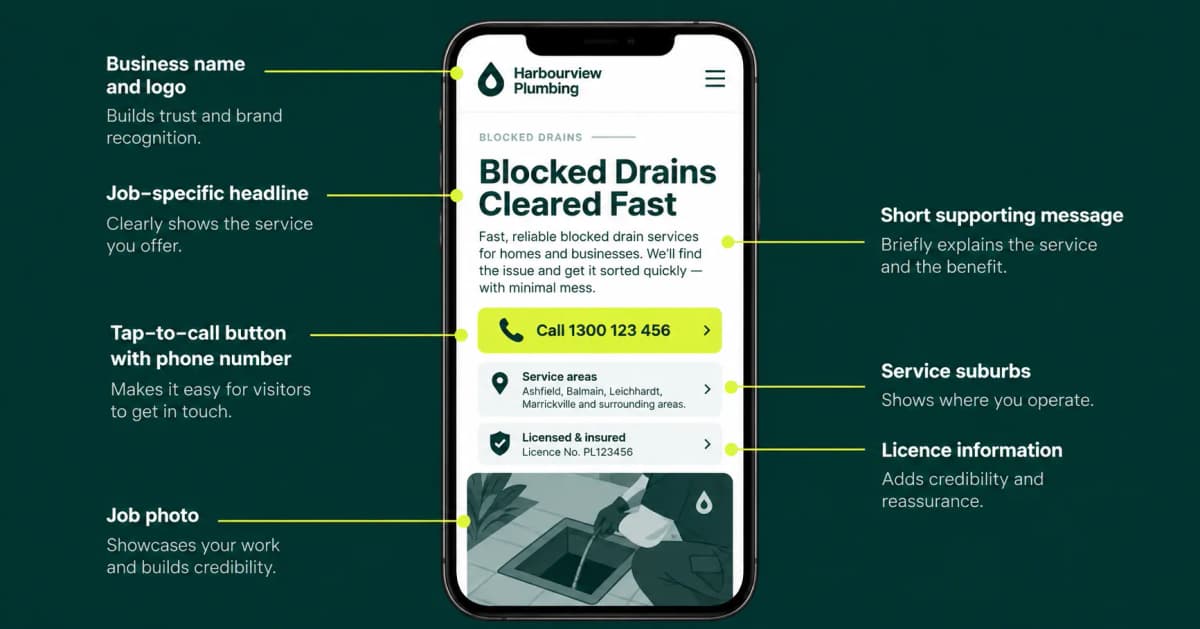
- Service pages can be the landing page — Build a page for each money service with the job in the headline, tap-to-call above the fold, suburbs, licence and photos, and send the matching ad there.
- Campaign pages come later — Strip the menu only when one service is spending, search terms are clean and calls are tracked. Keep the logo linked home and the licence line visible.
- Don't clone suburb pages — Google's spam policies treat near-identical pages aimed at different cities as doorway abuse. One page per service, with the areas you cover named on it.
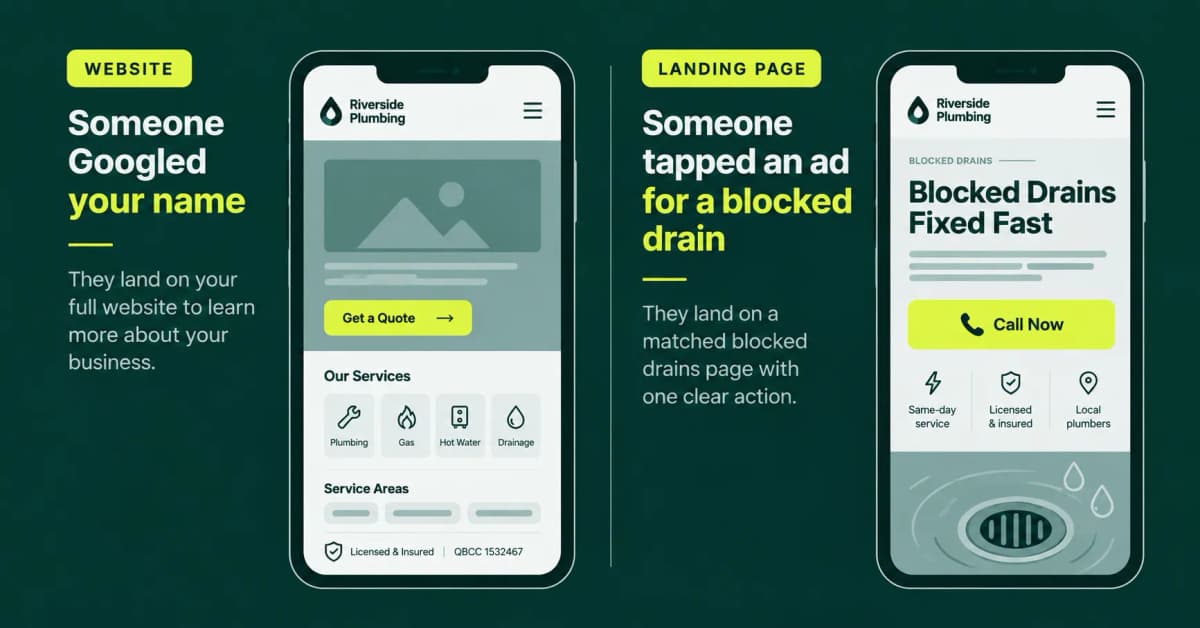
Someone in Marrickville has water coming back up the shower drain. They search "blocked drain Inner West", tap your ad and land on your homepage: plumbing, gas, hot water, about us, blog. They wanted a phone number. They got a menu.
That same evening, the neighbour of your last customer is handed your name. They Google it and find a single page about a drain-clearing special. No other services, no suburbs, no licence number, no photos of finished jobs. They can't tell whether you're a real business or a lead form, so they ring someone else.
Same tradie, two lost jobs, two different page problems. That's the real landing page vs website question. Most guides pick a winner. For most Australian trade businesses the honest answer is that you need both, doing different jobs, and that the pages you already need for SEO can carry most of the ad work until your spend justifies more. This guide covers what each page is for, where each one fails, what to put on the page by job type, and what a one-van operator should build first in 2026.
The short answer: you need a website, and a page matched to every ad
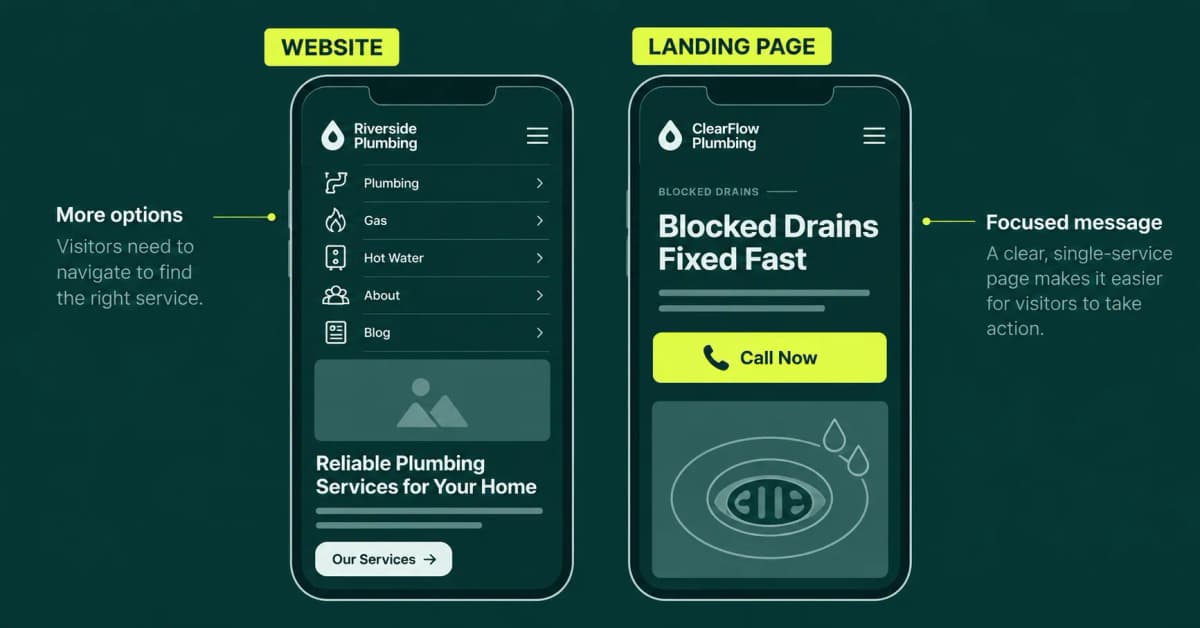
You need a small website if customers ever Google your name, and referrals almost always do. You need a page matched to the job if you're paying for clicks. A homepage is a poor place to send an ad. A single landing page is a poor place to send a referral.
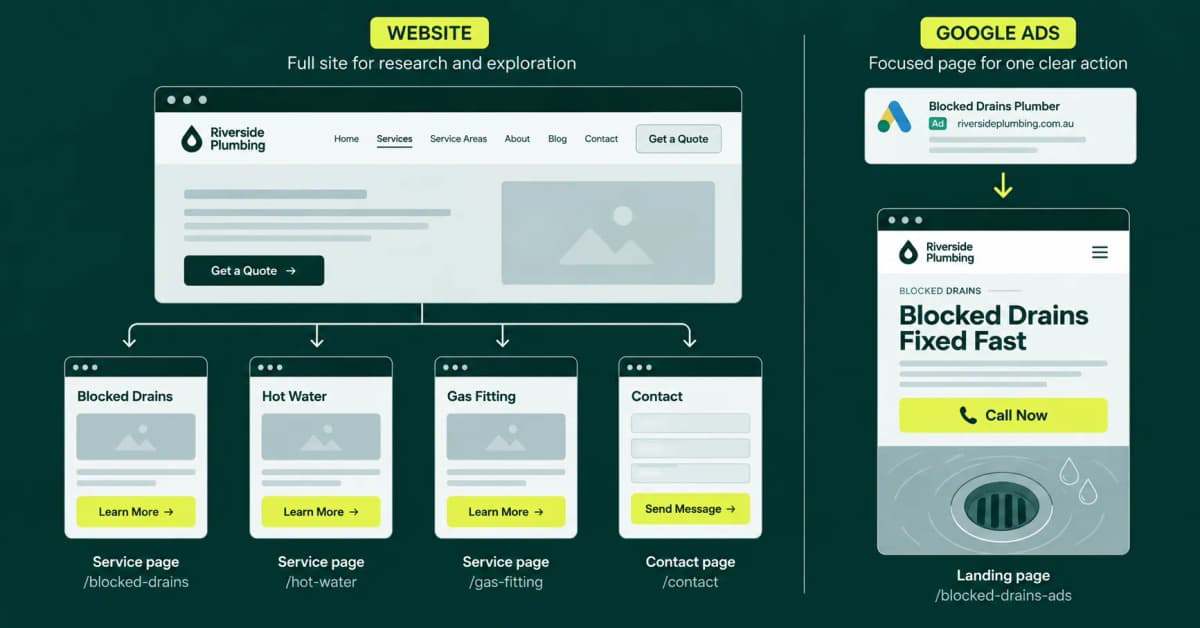
The good news is you don't need two separate builds to start. A proper website with a page for each service you sell covers both: the site answers the referral, and each service page takes the matching ad click. A separate, stripped-back campaign page only earns its place later, once one service is spending enough that the extra links on the page are costing you calls.
Landing page vs website: the main differences
A tradie website is the hub of your online presence. It has a homepage, a page for each main service, real job photos, the suburbs you cover, your licence line, reviews and a contact page. It's built for anyone who wants to check you out, and it's what Google reads to work out what you do and where.
A landing page is a page designed for one job. Someone tapped an ad for a blocked drain, so the page talks about blocked drains and asks them to take one action: call, or send a photo for a quote. Everything on the page is there to get that visitor to the desired action, and anything that distracts from it comes off.
Full website | Landing page | |
|---|---|---|
Its job | Show who you are, what you do, where you work and why to trust you | Turn one type of ad click into one call or enquiry |
Who arrives | Referrals, name searches, organic search, your Google Business Profile | People who tapped a specific ad (PPC) or campaign link |
Navigation | Full menu to every service and page | Little or none. Logo and phone stay. |
Number of pages | Several: home, service pages, about, contact | One page per campaign |
Should it rank in Google? | Yes. Service pages should be indexed and optimised for local search. | Not its job. It lives off the menu and gets its traffic from ads. |
Calls to action | Several, one per page | One, repeated |
Why your homepage wastes a paid click
The ad said "Blocked drains, Inner West, call now". The homepage says plumbing, gas, hot water, about, blog. The visitor now has to hunt for the thing they were just promised, on a phone, while the drain backs up. Some will find it. Plenty will hit the back button and tap the next ad, and you've paid for the click either way.
Google also judges the page your ad opens. Landing page experience is one of the three parts of Quality Score, which Google defines as how relevant and useful the page is to the person who clicked. Google's ad quality page says higher quality ads typically cost less per click and can earn better positions. A homepage that makes a blocked-drain searcher dig for blocked drains is working against both.
Google's own landing page advice reads like a brief for a tradie page: match the page to the ad and keyword, make it quick and easy to call or submit an enquiry, put the important information near the top so nobody has to scroll for it, keep navigation simple on mobile, and give useful, original information about the service. Its Quality Score guidance adds loading speed, which applies to every page you pay to send people to, landing page or homepage.
Why a lone landing page fails a referral
A one-page site is fine for a short test, or for a business that sells one service in one area. Once you sell more than that, a single page starts losing work.
It gives Google one URL for every service. A page that's about blocked drains, hot water, gas fitting and bathroom renovations all at once can't be the best result for any of them, so it struggles in organic search results for each. And it can't answer the person who already has your name.
A referral is a warm lead, but they still check. They search the business name and look for three things before they ring: are you licensed, do you work in their suburb, and do you do the job they need. A landing page built for one ad, with no menu and one offer, often can't answer any of them. A page with no way to find out who you are can look like a lead trap with a business name on top, which is the opposite of the first impression you want.
The same problem shows up on your Google Business Profile (it used to be called Google My Business). Google lets you add your website to the profile, and that button gets pressed by people looking for every kind of job. Point it at a page about one promotion and everyone who isn't buying that promotion is stranded. Link the profile to your homepage, or to your main service page if you genuinely sell one thing.
Service pages can take the ad click
Here's the part most of the landing page vs website debate skips: a well-built service page already is a landing page.
Build a normal page for each service that makes you money: blocked drains, hot water systems, switchboard upgrades, decks. Each one should have:
The job in the headline, such as "Blocked Drains Cleared Across the Inner West".
Your phone number above the fold, as a tap-to-call button on mobile.
The suburbs you cover for that work, named in a sentence or short list.
Your licence line.
Three or more real job photos, and a testimonial or two from customers who had that job done.
A short form for people who'd rather not call.
What's included, and the questions customers ask on the phone.
That page is indexed, sits in your menu and can rank for the service and the suburbs you name. Send the matching ad there. The blocked-drains ad opens the blocked-drains page, the switchboard ad opens the switchboard page. The visitor gets the job they searched for, with the rest of the site one tap away if they want to check you out. That's how a small site does the job of both a professional website and a set of landing pages from day one.
When a separate campaign page is worth building
A stripped-back campaign page, with the menu removed, earns its place when all of these are true:
One service is spending enough on ads that small gains in calls are worth real money.
Your search terms are clean, so the clicks are from genuine customers. If they aren't, a new page won't fix it. Our guide to poor quality Google Ads leads covers that first.
Calls and forms are tracked, so you can see whether the new page actually beats the service page.
You can see visitors leaving the service page through the menu instead of calling.
When you build it, remove the menu, not the business. Keep the logo linked to your homepage, the phone number, your licence line and a short footer with your business name and the areas you cover. Someone who wants to check who you are should be able to, in one tap. A page with no way back to the business asks a stranger to trust a form.
Keep campaign pages out of the main menu. They don't need to rank, because the ads bring their traffic, and your service pages are the ones that should be indexed and earning organic visits. Don't strip a page down for ads and then expect it to rank for the same service your indexed service page is built for.
What to put on the page, by job type
The right first screen depends on how urgent the job is.
Emergency jobs: lead with the phone
Burst pipe, blocked drain, power out, no hot water. The person searching wants someone now. The page needs a tap-to-call button they can't miss, the hours you answer, the suburbs you reach and how quickly you can get there. A long form is a wall. If you offer one at all, keep it below the call button and keep it to name, phone and suburb.
Planned jobs: lead with a short form
Bathroom renovation, switchboard upgrade, new deck, hot water replacement. These customers are comparing quotes, often after hours. Lead with a short request a quote form that lets them attach a photo of the job, then back it up with finished-job photos, the brands you install, your warranty and reviews. Keep the phone number visible for the ones who'd rather ring.
On every page: licence, suburbs, proof
Licence rules for advertising cover the web as well as the van. NSW Fair Trading says its building trade advertising rules apply to internet advertising, and that ads for specialist work such as plumbing, draining, gas fitting, electrical wiring and air conditioning must show the licensee's name, licence number with the correct category of work, and a business phone number. Other states have their own rules, so check with your regulator. Either way, a visible licence line helps build trust with a customer who has never heard of you.
What not to clone: one page per suburb
A common next step is to copy the landing page for every suburb: "Blocked Drains Newtown", "Blocked Drains Leichhardt", "Blocked Drains Ashfield", same words, new suburb name. Don't.
Google's spam policies list pages targeted at specific regions or cities that funnel users to one page, and substantially similar pages, as doorway abuse. The same policies list blocks of text naming the cities a page is trying to rank for as keyword stuffing. Sites that break these rules can rank lower or drop out of results.
Instead, build one page per money service and name the areas you cover on that page, in a sentence or a short list. Only add separate location pages where you can say something genuinely different about the work in that area, as our guide to local SEO for Australian tradies explains. Cloning a page with a new suburb name doesn't fix a weak offer. It just multiplies it.
What a one-van operator should build first
If you're starting from nothing, or from a single page, build in this order:
A homepage that says what you do, where you work and how to call, with your licence line.
Two or three service pages for the jobs that pay the bills, built to the checklist above.
A contact page with your phone, email, service area and a short form.
Tap-to-call on mobile on every page, and a domain name you own.
Your Google Business Profile linked to the homepage.
That's enough for referrals, for your profile and for a first ad test, with each ad sending people to its matching service page. If you're still deciding whether to start with ads at all, our guide to SEO vs Google Ads for tradies helps with that call.
Add a stripped campaign page only after the ads are spending, the search terms are clean and one service is producing calls. Website builders and landing page builders make it easy to put up a hosted one-page lead form before you have a site, and that can collect enquiries in a pinch. It doesn't replace the site a referral expects to find.
Landing page or full website: checklist for tradies
A small website with a homepage, a page for each money service and a contact page.
Every service page has the job in the headline, tap-to-call above the fold, the suburbs you cover, your licence line, real photos and a short form.
Each ad sends people to the page about that exact job, never the homepage.
Final URL expansion checked in Google Ads, so clicks land where you sent them.
Emergency pages lead with the phone. Planned-job pages lead with a short quote form with photo upload.
Google Business Profile website button points to the homepage, not a promotion.
Service pages are in the menu and indexed. Campaign pages are kept out of the menu.
Campaign pages keep the logo linked home, the phone, the licence line and a short footer.
One page per service, with suburbs named on the page. No cloned suburb pages.
Every page checked on a phone, on mobile data, before any ad goes live.
Calls and forms tracked, so you can compare a campaign page with the service page before you build more.
The landing page vs website question usually comes down to which visitor you're losing. Ad clicks dropped on a busy homepage leak calls. Referrals sent to a single offer page leak trust. Most tradies fix both with the same small site: a homepage, a page for each service, and ads matched to those pages, with a campaign page added only when the numbers say it's worth it. If you're not sure which leak is costing you, our web design and Google Ads teams look at both sides together, so you're not fixing the ad and ignoring the page it opens.
Frequently asked questions
Can I run Google Ads to my homepage?
You can, but it usually wastes clicks. Someone who tapped an ad for a blocked drain wants blocked drains, and a homepage makes them hunt through a menu to find it. Google rates how relevant and useful your landing page is to the person who clicked, and says higher quality ads typically cost less per click. Send each ad to the service page for that job instead.
Is a one-page website enough for a tradie?
Only if you sell one service in one area, or as a short-term test. A single page gives Google one URL for every service, so it struggles to rank for each of them, and it can't show a referral the rest of your business. Once you offer more than one service, a homepage, a page per service and a contact page will serve you better.
Should landing pages be in my website menu?
Service pages should be in the menu and indexed, because they're built to rank and to take ad clicks. A stripped-back campaign page built only for ads can stay out of the menu, since the ads bring its traffic. Keep your logo on it linked to the homepage so visitors can still check who you are.
How many service pages does a tradie website need?
One for each service that makes you money. For most one-van operators that's two or three to start: the jobs you most want more of. Add more as you add services, and only add separate suburb or location pages where you can say something genuinely different about the work in that area.
What should my Google Business Profile link to?
Usually your homepage. People tap that button looking for every kind of job, so it should open a page that shows all your services, the suburbs you cover and your licence. If you only sell one service, your main service page works too. Avoid linking it to a page about a single promotion.
What to read next

Web DesignUpdated
Tradie Website Conversion: Calls, Quote Forms and Clear CTAs
8 Oct 2026 · 8 min read

Meta AdsUpdated
Meta Ad Targeting for Tradies: Broad, Local or Retargeting?
8 Oct 2026 · 8 min read

Meta AdsUpdated
Facebook and Instagram Ads for Tradies: What They're Good For (and What They're Not)
7 Oct 2026 · 10 min read