
Your Tradie Website Explained: Domain, Hosting and Ownership
Your website isn't one thing you own. It's a domain licence, a hosting account, the site's files and a handful of logins, and each one can sit in someone else's name. Here's how each part works for Australian tradies, a five-minute check to see who controls yours, and how to fix it before you need to leave a provider.

Mitchell Gibb
Founder
On this page
Key takeaways
- It's four things, not one — Your domain, hosting, website files and logins are separate. Each can sit in a different person's name, and losing any one can take your site or email offline.
- The WHOIS name is the licence holder — For a .com.au, the business listed as registrant on auDA's WHOIS holds the licence, whoever pays the invoice or holds the password.
- Paying for a site isn't owning it — Under Australian copyright law, the creator of a commissioned website generally owns the copyright unless your contract assigns it to you in writing.
- Check it in five minutes — Look up your domain on the auDA WHOIS, confirm the expiry with auDA's password recovery tool, then check who holds the hosting, email and Google logins.
- Fix it while the relationship is good — Registrant transfers, logins and backups are easy to sort while your provider is cooperative and much harder after a falling out.
Picture a plumber who decides to leave the company that built their website three years ago. Every invoice has been paid, so they assume the site is theirs. Then the new web designer asks for the domain password, and it turns out the domain is registered in the old provider's name, the hosting sits on the provider's account and the business email runs through both. Nothing about the plumbing business has changed, but they can't move their own web address without the old provider's help.
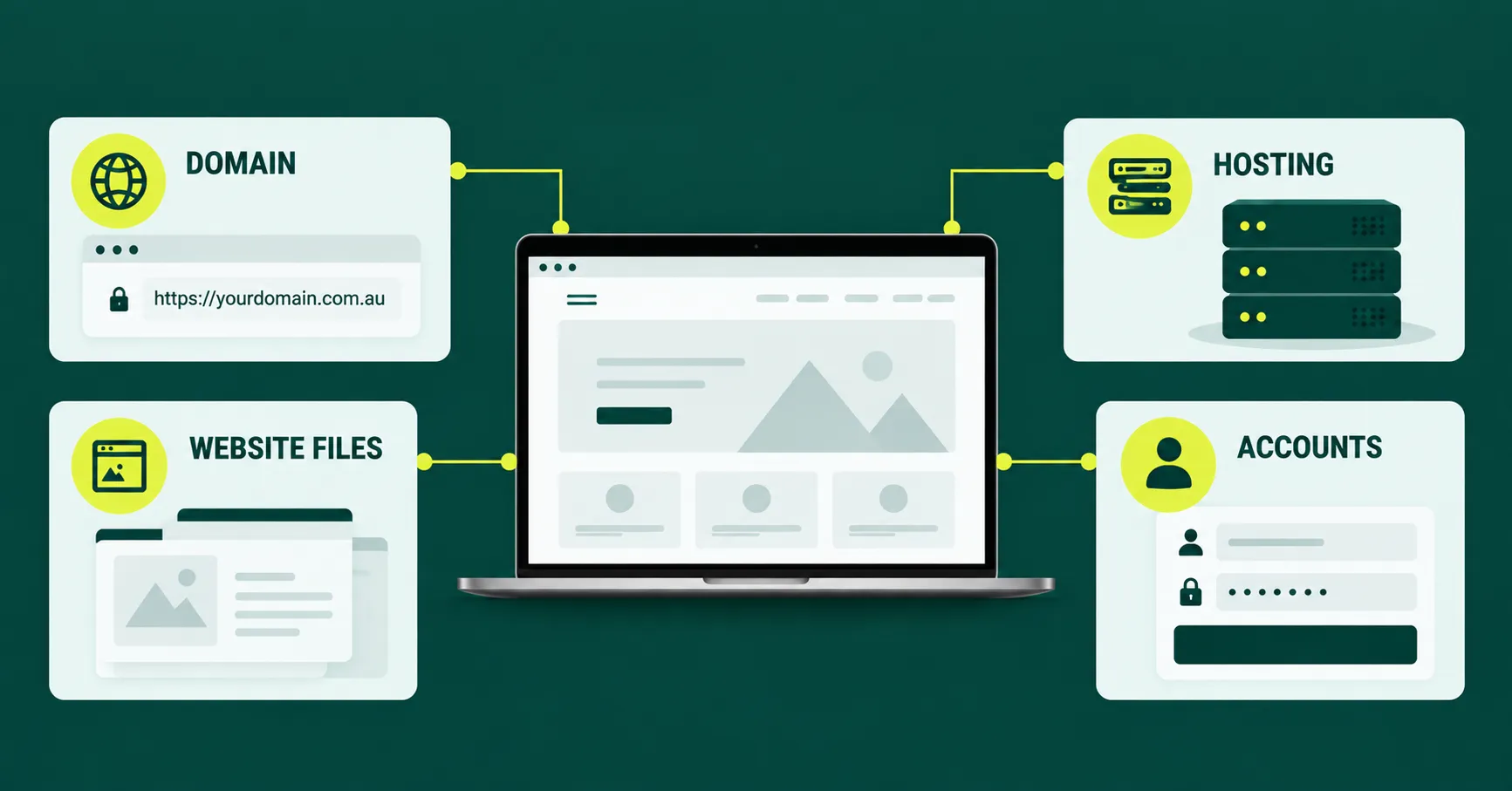
That's the catch with website ownership for tradies: a website isn't one thing you own. It's a domain licence, a hosting account, the site's files and a set of logins, and any of them can end up in someone else's name. This guide explains how each part works in Australia, walks you through a five-minute check to see who controls yours, and covers how to fix it, what to ask a web designer before you sign and what a clean handover includes.
Website ownership is four things, not one
When people talk about owning a website, they're usually talking about four separate things. Each one can be controlled by a different person, and you can lose one without losing the others.
Part | What it is | Think of it as | If someone else controls it |
|---|---|---|---|
Domain name | Your web address, and usually the end of your email address too | Your ute's rego: registered to a name, renewed on a schedule | They decide whether it renews, where it points and whether it moves |
Hosting | The server space where the website's files and database live | The workshop lease | They can switch the site off or hold on to the files |
The website | Design, code, text, photos and the content management system (CMS) | The fit-out inside the workshop | You may not be able to copy, change or move it without their say-so |
Logins and accounts | DNS settings, email, Google Business Profile, Google Analytics, Search Console and ad accounts | The keys | You can't make changes, see your data or switch providers without asking |
The safest setup is simple. Your business holds the domain licence and the main accounts, and your web designer or agency works on them with access you've given. That doesn't mean doing the technical work yourself. It means the things that belong to your business are in your business's name.
Your domain name is a licence, not a purchase
You don't buy a .com.au domain outright. You hold a licence to use it for a set term, under rules set by auDA, the .au Domain Administration. auDA says a com.au licence can be registered for one to five years at a time and renewed for as long as you still meet the requirements. It even compares a domain to a car registration: it doesn't come with the business automatically, it has to be registered or transferred to the right name.
To hold a .com.au, the registrant (the person or business named on the licence) must be an Australian commercial entity, which in practice usually means an active ABN or ACN. The domain also has to be connected to the business. Under section 2.4 of the .au Licensing Rules, that connection can be your business or company name, an acronym of it, your Australian trade mark, or a service you provide. So a roofer trading as Hendo's Roofing could register a domain matching that business name, its initials, or a service they offer such as roof restoration. The same eligibility rules apply to .net.au.
The registrant is the owner that counts
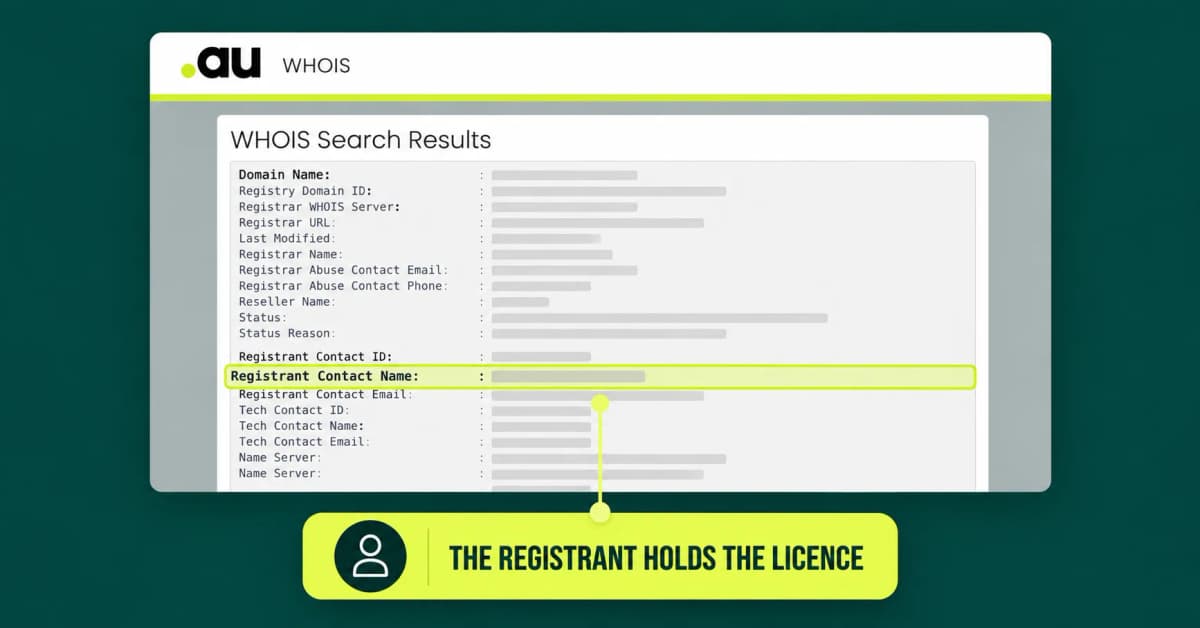
Whoever is listed as the registrant holds the licence. Not whoever paid the invoice, and not whoever has the login. auDA is direct about this: if your company name isn't in the WHOIS record, you aren't recorded as the licence holder, even if you hold the passwords and access.
auDA does let a web developer register a domain for you, as long as you've given written permission. The catch is that they should use your details, including your business name and ABN, as the registrant. If they use their own, auDA lists what can go wrong: the developer may not be eligible to hold your name, you depend on them staying in business, and the renewal notices go to them instead of you.
Registrars and resellers
Every .au domain is managed by an auDA-accredited registrar, known as the registrar of record. Many tradies never deal with the registrar directly because they bought the domain through a reseller, such as a hosting company or their web designer. That's normal, but you need to know who both are, because they're who you contact to renew, update details or transfer the domain. The WHOIS check further down shows you.
When the business changes hands or structure
Plenty of tradies start as sole traders and later set up a Pty Ltd. The company is a separate legal entity with its own ACN, so a domain registered to you as a sole trader stays with you until it's formally transferred to the company. Selling or buying a business works the same way. auDA says buying a business doesn't automatically transfer its domain, and when the licence is part of a sale it must be transferred within 28 days of the contract unless the agreement says otherwise. And if the ABN behind a com.au is cancelled, the holder is no longer eligible for it.
Hosting is where your website actually lives
Hosting is the server space that stores your website's files and database and delivers them to visitors. The domain is the address. Hosting is the building at that address. They're often bought from the same company, which is why people mix them up, but they're separate services and you can move one without moving the other.
DNS, the domain name system, connects the two. Your domain's DNS settings tell the internet where to find your website and where to deliver your email. Whoever controls those settings controls where your domain points, which is why a tradie can lose email just as easily as the website when DNS sits in someone else's account.
Whoever holds the hosting account controls the files, the backups and often the email mailboxes as well. If that's your web designer or agency, it isn't automatically a problem. Plenty of managed services host client sites on their own accounts. What matters is what happens when you leave: can you get a full copy of the site, including the database, and how quickly?
Do you own your website if you paid for it?
Not automatically. Under the Copyright Act 1968, copyright in most commissioned work belongs to the person who created it, with narrow exceptions such as commissioned private photos and portraits. Paying a designer to build your site doesn't, on its own, make your business the owner of the design or code. Copyright can be assigned in writing, which is why the contract matters.
That doesn't mean you can't use what you paid for. The grey area is what comes next: copying the site, moving it to a new host or having another designer rebuild from it. A short clause that assigns copyright to your business on final payment, or gives you a clear licence to use, change and move the site, heads off that argument.
Some parts are clearly yours, like the photos you took of your own jobs, the text you wrote and your customer enquiries. Others may not be. Stock photos, premium themes and paid plugins are licensed, and the licence may sit with your designer's account rather than your business.
How to check who controls your website in five minutes
You don't need to be technical for this. Grab your ABN, sit down at a laptop and work through these steps.
1. Look up your domain on the auDA WHOIS
Go to the official .au WHOIS lookup, run free by auDA, and enter your domain without the www (for example, yourbusiness.com.au). Then check these fields:
Field | What it tells you | Good sign | Red flag |
|---|---|---|---|
Registrant | The legal entity that holds the licence | Your company, or your own name if you're a sole trader | Your web designer, an agency, a former business partner or an old company |
Registrant ID and Eligibility ID | The ABN or ACN behind the licence | Your current ABN or ACN | Someone else's number, or an ABN you no longer use |
Eligibility Name | The business name used to qualify, if it differs from the registrant | Your registered business name | A business name you don't hold |
Registrant Contact Name and Email | Who receives renewal, transfer and password emails | You, or an address your business controls | A former employee, a mate or your designer's email |
Registrar Name and Reseller Name | Who manages the domain | Companies you recognise and can log in to | Names you've never heard of |
Tech Contact | Who handles the technical side | Often your designer or host, which is normal | Only a concern if you no longer deal with them |
Name Server | Where the domain's DNS is managed | A provider you have a login for | Servers run by someone you've stopped working with |
2. Check when the domain expires
The WHOIS won't show you an expiry date. auDA's WHOIS Policy explains that creation and expiry dates were removed because they were being used to send businesses unsolicited renewal notices. To see yours, use auDA's password recovery tool. It emails a single-use link showing the creation date, expiry date, registrar of record and the domain password.
3. Confirm your ABN still matches
Search your ABN on ABN Lookup and check it's active and matches the business on the WHOIS record. If you've changed structure, cancelled an old ABN or bought the business from someone else, this is where a mismatch shows up.
4. Find out who holds the hosting
Check who sends the hosting invoice or bill, and whether you can log in to the hosting control panel yourself. If the site runs on WordPress, make sure you have your own login with the Administrator role rather than a shared one. If the only login details sit with your designer, they control the files.
5. Check the logins around the website
Email: who can add or remove mailboxes, and whose account the email service is billed to.
Google Business Profile: Google lets a profile have several owners and managers but only one primary owner, and only the primary owner can hand that role over. It should be you, with your agency added as an owner or manager. Our guide to setting up Google Business Profile for tradies covers the rest of the setup.
Google Analytics, Search Console and ad accounts: these should sit under a Google account your business owns, with your agency given access. They hold years of data you can't get back once it's gone.
6. Find domains you've forgotten about
If different people have registered domains for you over the years, auDA can run a registry search for .au domains connected to your company name, trade mark, ACN or ABN. It has to come from you or an authorised representative of the business, with proof of identity.
Common website setups and what you actually control
None of these setups is wrong. They give you different levels of control, and the difference usually only shows up when you try to leave.
Setup | Domain | Hosting and files | If you stop paying | Ask before you sign |
|---|---|---|---|---|
Custom build, hosting in your business's name | Yours, if registered with your details | You hold the account and can give anyone access | The site stays live while the hosting and domain are renewed | Who handles updates, security and backups? |
Custom build, hosted on the agency's account | Depends who registered it, so check the WHOIS | The agency holds the files | Comes down to your contract and whether you can get the files | Will I get a full backup, files and database, if I leave? Is there a fee? |
Monthly website plan on the provider's own platform | Check whose name it's in before you sign | The provider's platform, which may not export | The site may go offline, even if you keep the domain | Can the site be exported, and will the domain be transferred to me? |
DIY website builder | Yours, if you registered it in your business's name | The platform runs the site | The site usually can't run anywhere else, so leaving means rebuilding | Am I happy to rebuild if I outgrow it? |
Set up by a mate, relative or ex-employee | Often in their name or on their email | Often on their personal account | Depends whether you can still reach them | Move everything into the business's name now, while you can |
The test is the same for all of them. If you stopped dealing with your current provider tomorrow, could the site stay online, and could someone else make changes without starting from scratch? A "no" is fine, as long as you knew that going in.
What happens if you stop paying your website provider?
It depends on which parts are in your name.
If the domain is registered to your business, it stays yours until the licence expires, and you can renew it through any provider. Point it at new hosting and you're back online, as long as you have a copy of the old site or a new one ready.
If the hosting or platform is theirs, the website itself comes down to your agreement. Read the exit terms before you need them.
Here's how that plays out. Say a deck builder has been on a monthly website plan for two years and wants to move to a new designer. The domain is in their business name, so it moves. The site was built on the provider's platform, so it doesn't. They keep the web address, the email and the website link on their Google listing, and the new designer builds a fresh site at the same address. Annoying, but no lasting damage. Had the domain been in the provider's name, they'd be starting again with a new address.
If the domain lapses
auDA gives you a 30-day grace period after expiry to renew. During that time the domain can't be used or updated, so your website and email stop working. If it isn't renewed, it's removed from the registry at the end of the 30 days and anyone eligible can register it, including people using "drop catching" services that grab names as soon as they're released.
For a trade business, that hurts more than it sounds. Your domain is on your quotes, your ute signage, your Google Business Profile and every directory listing, and it's usually your email address too. Moving to a new one means redirecting old links and updating every listing that points to the old address, which is a setback if you rely on local SEO to keep the phone ringing.
Domain in the wrong name? How to change the owner
Most ownership problems are easy to fix while the relationship with your provider is good and much harder after a falling out. Don't wait until you're leaving.
Ask for a registrant transfer. This is auDA's term for changing who holds the licence. You start it through the registrar or reseller. Both parties must be eligible on the day, the new registrant signs a new licence agreement and pays the licence fee, and any full years left on the licence carry across. Some providers charge a fee to process it.
Update the registrant contact email. Use an address your business controls and can still read if the domain ever lapses. If the only contact email is on the same domain, any notices sent after it expires won't reach you.
Get the domain password if you're changing registrar. Moving the domain to a new registrar needs its transfer authorisation code, also called the domain password, EPP code or authInfo code. It's different from your account login. Your current registrar sends it to the registrant contact email, or you can get it through auDA's password recovery tool. auDA says there's no fee for a transfer between registrars and it can take up to three days once approved.
Get a full backup of the site. Ask for the files and the database, plus the website's own login details, before you change anything else.
If they won't cooperate. If a domain has been registered using your ABN without your permission, auDA asks you to contact its team directly. For anything that becomes a dispute, auDA has a complaints and disputes process, and legal advice is worth getting. A domain that's under an active complaint or dispute can't be transferred until it's resolved.
Website handover checklist
Use this when you leave a provider, or better still, ask for it at the start so it never becomes an issue.
Domain registered to your business, with your ABN or ACN on the WHOIS record.
Registrant contact email set to an address your business controls.
A login to the registrar or reseller account in your name, or the domain password ready for a transfer.
The domain's expiry date in your calendar.
Hosting account in your name, or a full backup of the files and database.
Administrator access to the website's CMS.
A list of the domain's DNS records, including the ones your email depends on.
Admin access to your email service.
Primary ownership of your Google Business Profile.
Google Analytics, Search Console and ad accounts owned by your business, with the old provider's access removed.
Written confirmation of who owns the copyright, and a list of any licensed themes, plugins or stock photos and whose account they sit on.
Questions to ask a web designer before you sign
Whose name and ABN will the domain be registered in?
Whose account will the hosting be on, and what do I get if I leave?
Is there a fee or notice period to get my files and domain?
Who owns the copyright in the design and code once I've paid?
Will I get my own administrator login?
Can the site be moved to another host, or does it only run on your platform?
A provider who's confident in their work will answer these in writing before you sign.
Keeping your domain safe from here
Once everything is in your business's name, keeping it there is mostly admin.
Diarise the expiry date and think about renewing for longer. A com.au licence can run for up to five years at a time, although not every provider offers five-year terms.
Renew early. A .au licence can be renewed up to 90 days before it expires.
Consider the matching .au name. auDA suggests holding the .au direct version of your domain (yourbusiness.au alongside yourbusiness.com.au) and redirecting it to your main site, as brand protection.
Keep a record of your registrar, reseller and host so whoever opens the mail or pays the bills can check a domain invoice against it.
You don't need to understand servers to protect your website. You need your business on the domain licence, the hosting and the main accounts, and a copy of the site you can take with you. Run the WHOIS check tonight, fix anything in the wrong name while your current provider is still easy to deal with, and ask the handover questions before you sign with anyone new. Once that's sorted, the next job is making sure the site actually wins work, which our guide to tradie website conversion covers. If you'd like a hand, our web design team builds and rebuilds websites for Australian trade businesses and can look over your current setup with you.
Frequently asked questions
Who owns my website domain?
For a .au domain, the business or person listed as the registrant on the auDA WHOIS record holds the licence. That's true regardless of who paid for it or who has the login. If your web designer or agency is listed as the registrant, they hold the licence, not your business.
How do I check who owns my .com.au domain?
Search the domain on auDA's free WHOIS tool at whois.auda.org.au and check the Registrant and Registrant ID fields. They should show your business name and your current ABN or ACN. The WHOIS doesn't show expiry dates, so use auDA's password recovery tool at pw.auda.org.au, which emails the details to the registrant contact email.
What's the difference between a domain and hosting?
The domain is your web address, the name people type in to find you. Hosting is the server space where your website's files and database are stored. The domain's DNS settings point visitors to the hosting. They're often bought together, but they're separate services and you can move one without moving the other.
What happens if I stop paying my website provider?
It depends on what's in your name. A domain registered to your business stays yours until the licence expires, and you can renew it with any provider. A site hosted on the provider's account or built on their own platform may go offline when you stop paying, so check the exit terms in your contract and get a full backup first.
Should my web designer register the domain in their name?
No. auDA allows a developer to register a domain on your behalf with your written permission, but they should use your business details and ABN as the registrant. If they use their own, you rely on them to renew it, pass on notices and cooperate if you ever want to move.
Do I own my website if I paid for it?
Not automatically. Under Australian copyright law, the person who creates a commissioned work such as a website design generally owns the copyright unless it's assigned in writing. Check your contract, and ask for a clause that assigns copyright to your business or gives you a clear licence to use, change and move the site.
How do I transfer my domain to a new provider?
Get the domain's transfer authorisation code, also called the domain password or EPP code, from your current registrar or auDA's password recovery tool, then start the transfer with your new registrar. auDA says there's no fee for moving between registrars and it can take up to three days once approved. Changing who holds the licence is a separate process called a registrant transfer.