9 Best Marketing Channels for Plumbers in Australia 2026
Which marketing channels actually book plumbing jobs in Australia? Here's the order to build them in, which suit emergency or planned work, where to start for your business size, and how to compare channels on cost per booked job.

Mitchell Gibb
Founder
On this page
Key takeaways
- Build owned channels first — Google Business Profile, reviews and a website in your business's name keep producing work after you stop paying. Ads and lead platforms stop when the money does.
- Match the channel to the job — Emergency jobs come from map results, reviews and Google Search Ads. Planned jobs also respond to your website, local SEO, social media, Meta ads and past customers.
- Judge on cost per booked job — Cost per click and cost per lead can make a channel look cheap. Divide what you spent by the jobs it booked, then compare that with what the jobs were worth.
- Don't ignore work you've already won — Past customers, recurring work, property managers and builders are often the cheapest jobs you'll book.
- Answer the phone — A missed call usually goes to the next plumber on the map. Cover your advertised hours and text back missed calls within minutes.
Most plumbers get pitched the same way. One rep wants you on a lead platform, another wants to run your Google Ads, and someone at the supplier swears Facebook is where the work is. They can't all come first. For a plumbing business, the order you build your marketing in matters more than the list of channels, because the jobs that pay the bills get booked fast. A burst pipe at 7am goes to whichever local plumber shows up first on a phone and answers when it rings.
This guide ranks nine marketing channels for plumbers in Australia, shows which suit emergency work and which suit planned jobs, and gives you a starting point for your business size, plus a simple way to compare channels on cost per booked job.
The best marketing channels for plumbers, in order
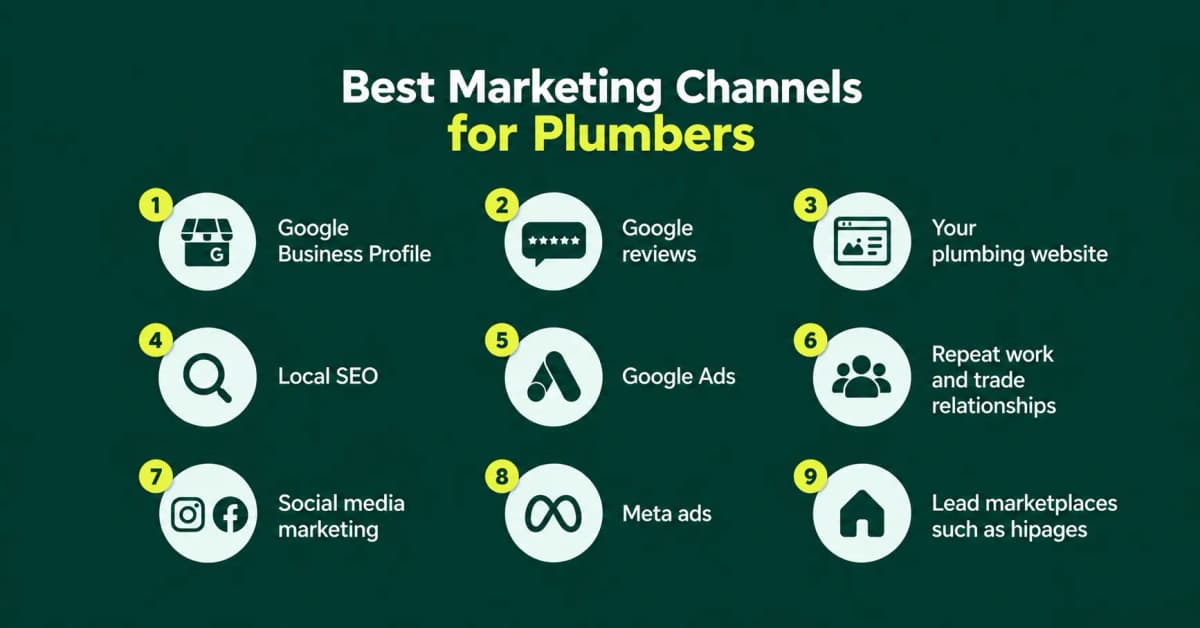
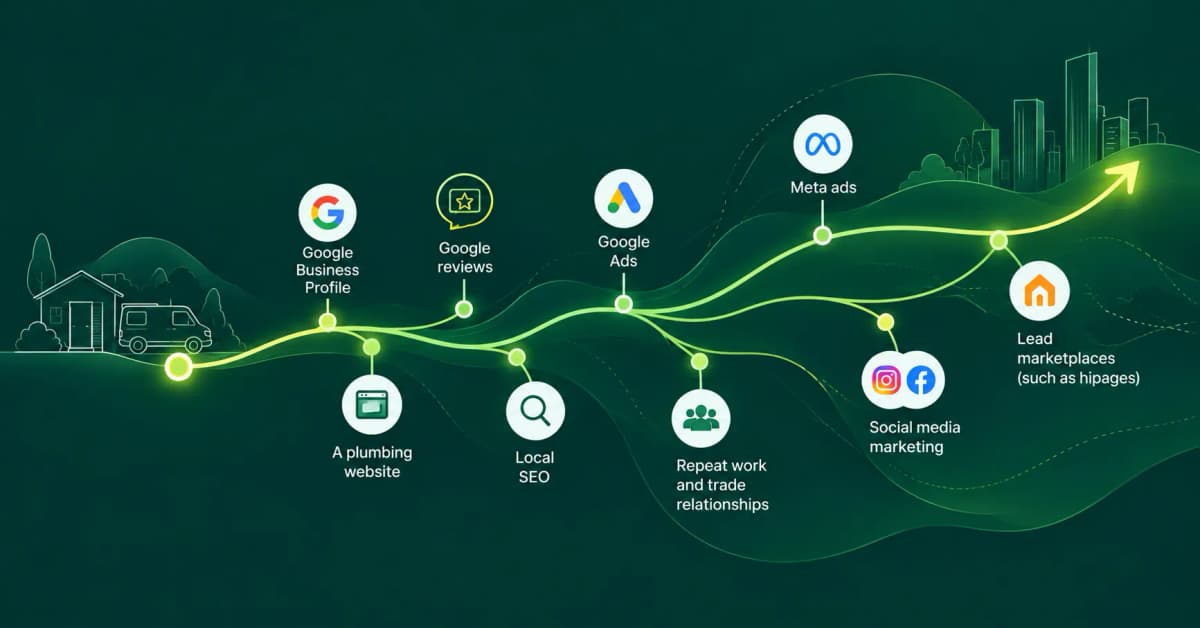
For most Australian plumbing businesses, this is the order to build in:
Google Business Profile. Free, and it puts you in the map results when someone searches "plumber near me" with water on the floor.
Google reviews. Once someone is looking at three plumbers on a map, reviews usually decide who gets the call.
A plumbing website you own. Where calls and quote requests happen, and where your ads send people.
Local SEO. Gets your service and suburb pages found in Google's organic results.
Google Search Ads. The fastest paid way to reach someone who needs a plumber today.
Repeat work and trade relationships. Past customers, property managers and builders. Often the cheapest jobs you'll win.
Social media marketing. Rarely brings in emergency calls, but customers check it before they book planned work.
Meta ads. Paid Facebook and Instagram ads for planned work like hot water upgrades. Not for burst pipes.
Lead marketplaces such as hipages. A top-up while the channels above build, not a foundation.
Build the channels you own first, because they keep producing work after you stop paying for them. Then pay for attention once there's something solid for it to land on. It's a build order rather than a strict queue: plenty of plumbers run local SEO and Google Ads side by side, with ads bringing in calls now while SEO builds.
Two things to know before you pick a channel
Owned vs rented channels
Your Google profile, reviews, website and customer list are owned. They take time to build, and every review, photo or page adds to what's already there. Ads and lead platforms are rented. They bring in calls this week and stop the day the money does. Social media sits in between: you own the posts, but the platform decides who sees them.
Emergency jobs vs planned jobs
The emergency customer has water through the ceiling or no hot water before work. They search on a phone, check the top few results and call the first plumber who looks trustworthy. Being near the top, a reassuring star rating and someone answering the phone win that job.
The planned customer is replacing an ageing hot water system or renovating a bathroom. They compare two or three plumbers and usually want a quote first, so your website, reviews and quoting speed matter more. Work out which side your profit comes from before you choose a paid channel.
Channel | Owned or rented | Speed | Best for |
|---|---|---|---|
Google Business Profile | Owned | Steady once set up | Emergency and planned work |
Google reviews | Owned | Grows with every job | Emergency and planned work |
Website | Owned, if it's in your name | Weeks to build | Planned work, and somewhere for ads to land |
Local SEO | Owned | Months | Service and suburb searches |
Google Search Ads | Rented | Days | Emergency and high-value jobs |
Repeat and trade work | Owned | Builds over time | Recurring, builder and strata work |
Social media marketing | Owned posts, rented reach | Slow | Trust and planned work |
Meta ads | Rented | Days to weeks | Planned, higher-value jobs |
Lead marketplaces | Rented | Days | Filling quiet weeks |
1. Google Business Profile: how plumbers get into the map results
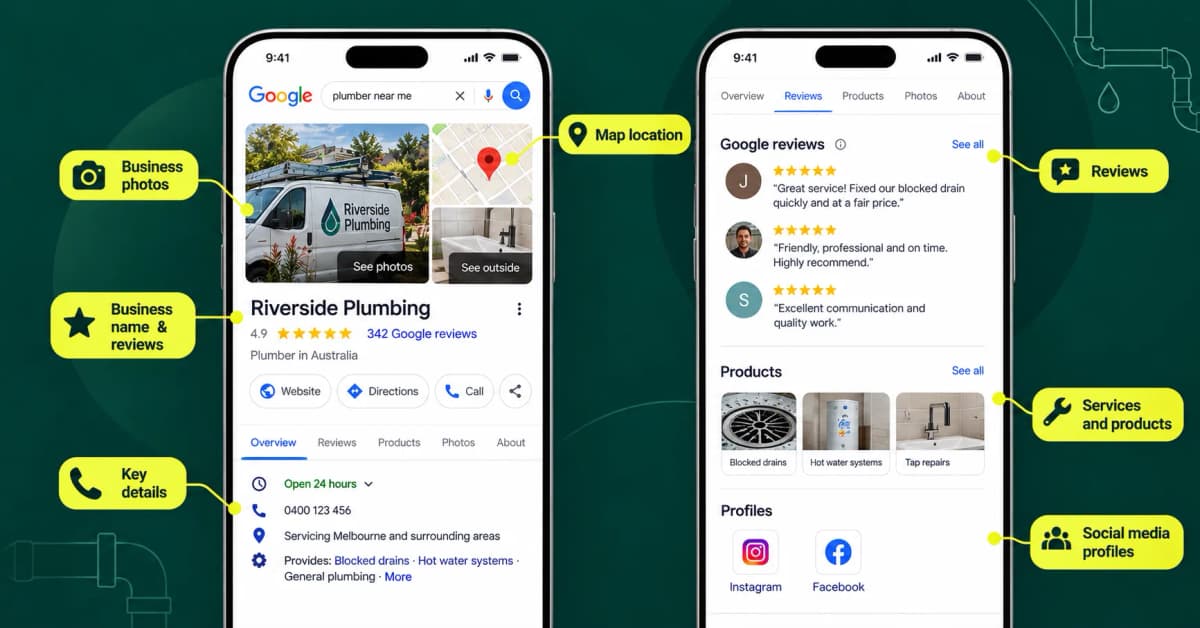
Your Google Business Profile is the listing that shows in Google Maps and in the map results at the top of local searches. For emergency work it's often the only thing a customer checks before calling, and you can't pay for a spot there. Google ranks those results on how relevant, how close and how well known each business is. Distance is out of your hands. Most of the rest isn't.
What to set up
Category: "Plumber" as your primary category, with others only for work that's a genuine part of the business.
Service area: if you work from home, hide the address and list the suburbs you really cover.
Hours: the hours someone will actually answer, including after-hours if you take those calls.
Services, photos and description: every service you want to be found for, real job photos and your licence number.
What puts your profile at risk
A suspended profile drops off the map until it's fixed. The usual causes for plumbers all break Google's guidelines for Business Profiles: keywords in the business name ("Smith Plumbing Emergency Plumber Penrith"), a PO box or virtual office as the address, two profiles for one business, and a service area stretching more than about two hours' drive from base.
2. Google reviews: what tips the call your way
Why reviews decide who gets the call
Reviews help twice. Your review count and rating feed into how prominent Google thinks your business is, and once someone is comparing three plumbers on the map, reviews usually decide who gets the call. A plumber with 80 recent reviews and one with four old ones don't look like the same risk to someone about to let a stranger into their house.
A review routine that stays within the rules
The plumbers with the most reviews aren't necessarily better plumbers. They just ask every time. Save your review link in your phone and text it the same day the job's finished: "Thanks for having us out today. If you've got a minute, a Google review helps other locals find us: [link]." Send it to every customer, not just the ones you're sure loved you.
Reply to every review within a few days. With a bad one, acknowledge the problem, say what you'll do and offer to sort it out by phone. You're writing for the next customer who reads it, not only the person who left it.
3. Your plumbing website: where calls and quotes happen
Your website and your SEO often get lumped together, but they do different jobs. SEO brings people to the site. The website has to turn them into a call or a quote request, whether they found you on Google, through an ad or on the side of your van.
What a plumbing website needs
An emergency customer might give your site ten seconds, and a bathroom renovation customer ten minutes. Both need to see that you do their job in their suburb, and both need a quick way to call or ask for a quote. If you're building a new site or fixing an old one, check it has:
Tap-to-call at the top of every page, and a call button that stays on screen on a phone
Your services and service area on the first screen
Your licence number and real photos of your jobs, van and team
A short quote form for planned work: name, mobile, suburb and job type
Pages that load quickly on a phone
Make sure you actually own it
If your domain is registered to the web designer, agency or mate who set it up, or the hosting sits in their account, you depend on them for every change. Most tradies don't find out until they try to leave, which is why website ownership matters more than it looks. Check that the domain is registered to your business, that you can get a full copy of the site, and that you have your own admin login.
4. Local SEO: getting your website found for plumbing searches
Your Google Business Profile is the map half of local SEO. The other half is getting your own pages into the organic results under the map for the services and suburbs you want. It takes months rather than weeks, but a page that ranks keeps bringing in calls without a cost per click.
Service pages and suburb pages
Give each money service its own page: blocked drains, hot water, leak detection, gas fitting, backflow testing. A single services page listing everything rarely ranks for any of them. Add suburb pages only where you have real jobs to show. Dozens of near-identical pages with only the suburb name swapped are what Google treats as doorway pages, and they can pull your rankings down.
Useful content and local links
Short pages that answer questions customers already ask you, like why a hot water relief valve is dripping, earn searches and show you know the job. They're also the kind of page AI tools like ChatGPT pick up when someone asks a plumbing question.
Links from businesses you actually deal with help too: suppliers that list accredited installers, your trade association, builders you work with and local clubs you sponsor. Keep your business name and phone number identical on every directory, and don't buy links, which breaks Google's spam rules.
5. Google Search Ads: paying to be first when it's urgent
Why search ads suit urgent plumbing work
Search ads put you at the top of the results for the searches and suburbs you choose, often within days of starting. The customer with a burst pipe isn't scrolling to page two, and ads cover the gap while your profile, reviews and SEO are still building.
How to keep a plumbing campaign tight
Search ads are also the easiest channel to waste money on. A broad keyword like "plumber" pulls in apprentices, DIYers and people checking plumber salaries, and those clicks turn into poor-quality leads.
Bid on jobs, not the trade: "blocked drain [suburb]", "hot water repair", "burst pipe plumber".
Add negative keywords from day one, such as DIY, Bunnings, apprenticeship and salary.
Run ads only when someone will answer the phone.
Send each ad to the matching service page or a dedicated landing page, not your homepage.
Put your licence number in your ads too. NSW requires the licensee's name and licence number in all advertising, Queensland's QBCC has a similar rule, and other states set their own.
6. Repeat work, referrals and trade relationships
Most marketing advice for plumbers is about finding strangers, but some of your cheapest jobs come from people who already know you.
Past customers and recurring work
Keep a list of every customer, what you did and when. An ageing hot water system you installed or a backflow device due for its annual test is a reason to get back in touch, and one well-timed message beats a monthly newsletter nobody reads. If you send marketing by email or SMS, the Spam Act rules mean you need consent and an unsubscribe option, so add a consent tick box to your job sheet.
Property managers, strata managers and builders
Real estate agencies and strata managers need plumbers who turn up, keep tenants informed and send clear invoices with photos, and they stick with the ones who do. Builders and renovators pass work to plumbers they trust to show up when they say. Your van signage and the licence number on every quote help with all of them.
7. Social media marketing: trust and planned work, not emergencies
This means your own Facebook page, Instagram account and the posts on them. Paid ads on the same platforms are the next channel.
What social media does for a plumber
It rarely brings in a burst pipe call, because someone with water on the floor searches Google. What it does is quieter. Customers comparing plumbers for planned work look you up before they book, an active page with real jobs is social proof, and local community groups are where neighbours ask "anyone know a good plumber?" The catch is reach: you own the posts, but the platform decides who sees them.
What to post
Pick Facebook, Instagram or both, and post real work consistently: before-and-after photos, short clips of problems you find and fix, your team and vans, and seasonal reminders like getting an ageing hot water system checked before winter. Ask before you post photos of a customer's home, and leave out house numbers. A few photos on every job is enough to keep a page going on an hour a week.
8. Meta ads: paid social for planned plumbing jobs
Where Meta ads fit
Facebook and Instagram ads reach people who weren't searching for a plumber. That makes them a poor fit for emergencies and a reasonable one for planned, higher-value work, where you can start the conversation early. Expect these leads to need more follow-up than a search call.
Plumbing jobs worth advertising
Hot water upgrades, such as switching to a heat pump
Bathroom and kitchen renovation plumbing
Gas appliance installs
Retargeting people who visited your website but didn't call
Start once search is working and your website gets steady traffic.
9. hipages, ServiceSeeking and other lead marketplaces
How lead marketplaces work
A customer posts a job and the platform passes it to local businesses who pay to respond. hipages says each lead goes to no more than three businesses, and you pay through a monthly plan plus credits for each lead you accept, win or lose. ServiceSeeking runs on paid memberships. Pricing on both changes, so check the current terms before you sign up.
How to use them without relying on them
Marketplaces are useful when you're new with no reviews, or when the diary has a gap. But a shared lead is a quote race that price often decides, and nothing you spend builds anything you keep. Track cost per booked job on each platform, respond fast, and lean on them less as your own profile and website start producing calls.
Which channels should your plumbing business start with?
Solo plumber or just starting out
Complete your Google Business Profile and ask every customer for a review.
Get a simple, mobile-friendly website registered in your business's name.
Set up a Facebook page with a few real job photos, without expecting calls from it.
Tell the builders and property managers you know that you're taking on work.
If the diary's empty, add one paid option: a lead platform or a small Google Ads campaign on emergency searches nearby. Not both.
Growing business: one to three vans
Run Google Search Ads on emergency and high-value searches, funded properly rather than spread thin.
Start local SEO properly, with service pages, real suburb pages and links from suppliers and builders.
Set up call tracking so you know which channel booked each job.
Build a past-customer list with consent, and set reminders for recurring work.
Established multi-van operation
Cover every area your vans work with service and suburb pages backed by real jobs.
Split Search Ads campaigns by service so you can see the cost per job for each.
Put someone in charge of property manager, strata and builder relationships.
Use Meta ads and retargeting for planned work and seasonal pushes.
Make sure the phones are covered. More vans means more calls to miss.
At every stage, fund one paid channel properly before adding the next.
How to compare channels: cost per booked job
Cost per click and cost per lead are easy to measure and easy to be misled by. The number that matters is cost per booked job: what you spent on a channel in a month, divided by the jobs it actually booked.
Here's a fictional month for a two-van plumbing business:
Channel | Spent | Enquiries | Booked jobs | Cost per booked job | Revenue from those jobs |
|---|---|---|---|---|---|
Google Search Ads | $2,000 | 32 | 14 | $143 | $9,100 |
Lead marketplace | $600 | 25 | 5 | $120 | $1,900 |
Google Business Profile and reviews | $480 (6 hours of your time at $80) | 18 | 11 | $44 | $5,720 |
On cost per enquiry, the marketplace looks best at $24 a lead against $62.50 for ads. On cost per booked job they're close, at $120 and $143, because most of the shared leads went to someone else. Add revenue and the picture changes again: about $4.55 back for every dollar on ads, $3.17 on the marketplace, and close to $12 on the profile, which only cost time.
To get these numbers for your own business, use tracked phone numbers on your ads and website, set up conversion tracking in Google Ads, and ask every new customer "How did you find us?" Once a month, line up spend, booked jobs and revenue for each channel.
The leak that costs plumbers the most jobs
A lot of plumbing leads are lost after the marketing has done its job. The customer called, nobody answered, and they rang the next plumber on the map.
Answer or forward every call during the hours you advertise.
Text back missed calls within minutes.
Call back form enquiries within the hour where you can, and quote planned work the next day.
If your profile says 24/7, make sure someone answers at 2am.
Common marketing mistakes plumbers make
Starting every channel at once. None of them gets enough budget or time to work.
Relying on one rented channel. A price rise or an account problem can empty the diary.
Building on a website or profile you don't own. Everything you add belongs to whoever holds the logins.
Judging channels on clicks or leads. Only booked jobs pay the bills.
Advertising hours you don't answer. An unanswered call costs you the click and the job.
There's no single best marketing channel for plumbers, but there is a best order: a complete Google Business Profile, steady reviews and a website you own with local SEO behind it, then paid ads once there's something worth sending people to. Judge every channel on the jobs it books, and answer the phone.
If you'd like help working out which channels fit your plumbing business, Trusted Digital works with Australian trade businesses on SEO, Google Ads, Meta Ads and web design. A free SEO audit is an easy place to start, and we'll tell you what to fix first, even if that's the free profile work.
Frequently asked questions
What is the best marketing for plumbers in Australia?
For most plumbing businesses, a complete Google Business Profile, steady Google reviews and a website you own with local SEO behind it give the best return, because they keep producing calls without a cost per click. Google Search Ads come next for emergency and high-value work. Social media builds trust, Meta ads suit planned jobs, and lead marketplaces work best as a top-up.
What's the best marketing for a plumber just starting out?
Start with the free channels: complete your Google Business Profile, ask every customer for a review and get a simple website registered in your business's name. If you need work straight away, add one paid option, either a lead platform or a small Google Ads campaign on emergency searches near you, rather than both.
Is SEO worth it for plumbers?
For most plumbing businesses planning to be around for a few years, yes. Local SEO takes months to build, but a service or suburb page that ranks keeps bringing in calls without a cost per click. If you need calls this month, run Google Ads while SEO builds.
Is Google Ads or Facebook better for plumbers?
For emergency work, Google Ads, because people with a burst pipe or blocked drain search Google and call within minutes. Facebook and Instagram ads can work for planned jobs like hot water upgrades or bathroom plumbing, so get search working first and add Meta later.
Does social media get plumbers work?
Rarely emergency work. It helps in quieter ways: customers check your page before booking planned jobs, neighbours ask for recommendations in local community groups, and regular posts keep past customers aware of you.
How much should a plumber spend on marketing?
There's no single right figure. Work backwards from what you can afford to pay for a booked job, based on your average job value and margin, and give any paid channel enough budget to show a pattern before you judge it. If the budget's tight, narrow the test to fewer suburbs or services rather than spreading it thin.
Is hipages worth it for plumbers?
As a top-up, it can be. It fills quiet weeks and helps when you have no reviews yet. But leads are shared with other businesses and you pay for the leads you accept whether or not you win the job, so track cost per booked job and rely on it less as your own channels grow.
Are Google Local Services Ads available in Australia?
Not when we checked on 15 October 2026. Google's Local Services Ads help centre listed 11 countries, and Australia wasn't among them. Availability can change, so check Google's current list before paying anyone to set them up.